Timetable first, infrastructure second? What Poland's railway plans can teach the rest of Europe
If you ask most people what makes a railway successful, they are likely to mention faster trains, new lines or modern stations. Poland's proposed Horizontal Timetable (Horyzontalny Rozkład Jazdy, or HRJ) begins with a different question altogether:
What sort of railway do passengers actually need?
That may sound like a subtle distinction, but it represents a fundamentally different way of thinking about railway planning. Rather than asking what timetable can be produced from the available infrastructure, the project begins by considering the service passengers should receive. Only then does it ask what infrastructure, rolling stock and operating pattern will be needed to deliver it.
Students of European railway planning will recognise many familiar ideas. Switzerland's Bahn 2000 programme demonstrated that designing the timetable first—and then building the infrastructure needed to operate it—could produce a railway that was not only faster, but also easier to understand and use. Many of the same principles are now evident in Poland's proposals.
At the heart of the HRJ is a nationwide clock-face timetable. Trains on the principal routes would operate at regular intervals, typically every 30 minutes, every hour or every two hours, with departures repeating at the same minutes past each hour throughout the day. Rather than treating each individual service as a separate path through the network, the railway would operate to a repeating pattern that passengers could quickly learn and understand.
Yet the timetable itself is only one part of a much bigger picture.
Perhaps the most significant aspect of the proposal is that the timetable becomes the starting point for almost every other decision. Infrastructure, rolling stock, service patterns and even market organisation are all intended to support a single, coherent operating plan.
This philosophy is evident throughout the proposal. Rather than building infrastructure and seeing what timetable emerges afterwards, the planners intend to use the timetable to identify where additional tracks, platforms, junctions, passing loops or signalling improvements are actually required. Investment is therefore directed towards delivering a defined service pattern, rather than simply achieving the highest possible line speeds.
That mirrors one of the key lessons of Bahn 2000. In Switzerland, relatively modest infrastructure improvements were often undertaken not because they dramatically reduced journey times, but because they saved just enough time for trains to meet at the right station, at the right minute, every hour. Reliable connections became just as important as maximum speed.
The proposed network itself reflects this integrated approach.
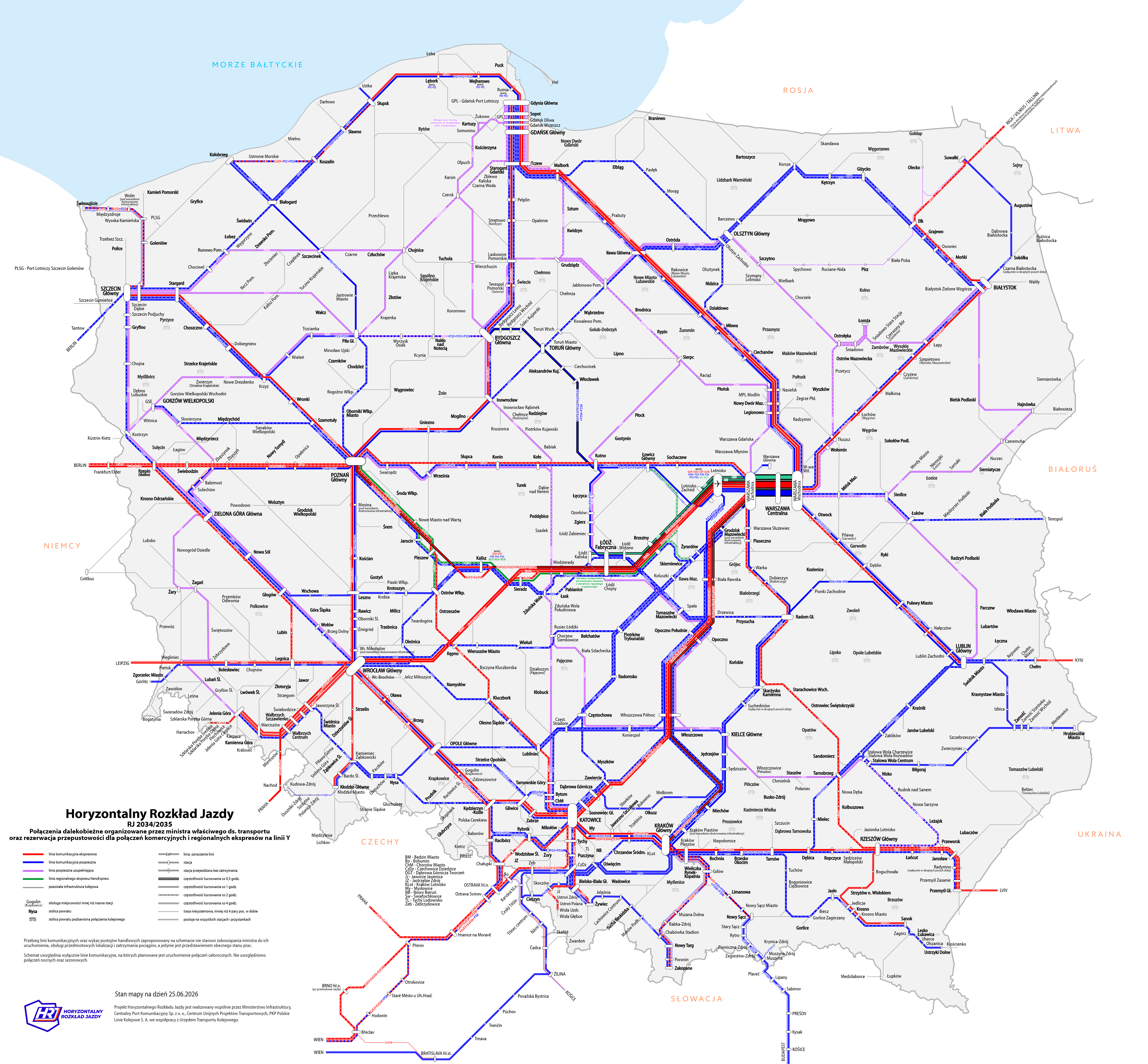
High-speed services on the future "Y" line linking Warszawa, Łódź, Poznań and Wrocław are only one element of the system. Rather than expecting every community to lie directly on a high-speed railway, the proposals introduce several complementary service types. RegioExpress services would use sections of the high-speed network to bring faster journeys to nearby towns, while supplementary express trains would continue to serve medium-sized centres that might otherwise lose direct long-distance links.
Even the proposed AeroExpress trains are conceived as more than simply airport services. Running between Warszawa, the new Central Communication Port (CPK) and Łódź, they are intended to provide frequent interurban connections for everyday travellers as well as airport passengers. The planned service of more than 100 daily trains between Łódź and Warszawa illustrates how the new infrastructure is expected to support both long-distance and regional travel.
Regional services also play a central role in the proposals. Rather than existing as a separate network, they are intended to connect seamlessly with long-distance trains through carefully timed transfers. The consultation process has already involved regional transport authorities across Poland in an attempt to develop a coordinated national network extending well beyond the long-distance railway itself.
Even where rail services are not considered viable, the intention is that scheduled feeder buses should provide guaranteed links to railway stations. The objective is not simply to operate more trains, but to create an integrated public transport system in which trains, regional services and buses all work together.
This integrated philosophy also extends to the future organisation of Poland's railway market. The Horizontal Timetable is intended to provide the framework for competitive tendering of long-distance passenger services from December 2030, allowing operators alongside PKP Intercity to deliver services within a nationally coordinated timetable while maintaining convenient connections for passengers.
One comment from Deputy Infrastructure Minister Piotr Malepszak perhaps captures the philosophy better than any planning document could.
"You cannot build infrastructure to then offer four trains a day on it. We want the infrastructure built for hundreds of millions to be filled with trains."
It is a remarkably simple observation, yet one that underpins the entire project. Infrastructure exists to carry trains, and trains exist to carry passengers. The timetable becomes the mechanism that links the two.
Of course, there remains a considerable distance between an ambitious planning document and a fully implemented railway. Delivering a nationwide integrated timetable will require sustained investment, political commitment and close cooperation between infrastructure managers, operators and regional authorities. Switzerland's own transformation took decades rather than years.
Whether Poland ultimately achieves everything set out in the Horizontal Timetable remains to be seen.
What is already clear, however, is that the proposal represents a significant shift in thinking. Rather than viewing the timetable as the final product of railway planning, it places the timetable at the very beginning of the process.
For readers of the European Rail Timetable, that may be the most interesting aspect of all.
A timetable is normally regarded as the end result of railway planning. Poland's Horizontal Timetable suggests it should instead become the blueprint from which the entire railway is designed.
You can view diagrams of the proposed services here and here.
The Summer 2026 edition of the European Rail Timetable is available NOW in print and digital formats and is the perfect partner to our Rail Map Europe.