When most people think of a regional train, they picture a short journey. A service linking neighbouring towns. A commuter train carrying passengers into the nearest city. Something to board for half an hour before changing to an intercity or high-speed service for the longer part of the journey.
Across much of Europe, however, that assumption does not always hold true.
Hidden within the railway network are regional trains that travel for hundreds of kilometres, sometimes taking four, five or even six hours to complete their journeys. They may not offer the speed of an express service, but they often provide something rather different: direct links between towns and cities, an opportunity to see more of the landscape, and in many cases the freedom to travel without compulsory reservations or supplements.
Far from being curiosities, these trains are an important part of the railway network. Some connect regions that have never justified a dedicated intercity service. Others have grown from linking several regional routes together into a single through service. In some countries, the distinction between regional and long-distance trains is far less rigid than travellers might expect.
Here are five regional trains that prove you do not always need an intercity train to travel a long way.
Norwich to Liverpool: Crossing England from east to west (Table 206)
Britain's railways are often thought of as a collection of separate regional networks, with longer journeys requiring a change onto an intercity service. Yet one regional service quietly crosses much of England on an almost hourly basis, linking eastern England with the north-west without requiring a single change.
The service between Norwich and Liverpool covers around 408 kilometres, taking approximately five and a half hours to complete its journey. Along the way it serves a remarkable number of important towns and cities, including Ely, Peterborough, Nottingham, Sheffield and Manchester.
In fact, this single regional service connects seven of the United Kingdom's cities, linking East Anglia, the East Midlands, South Yorkshire and North-West England in one continuous journey.
The route also illustrates something distinctive about Britain's railway geography. Rather than following a single obvious corridor, the train stitches together several different parts of the network. From Norwich it crosses the landscapes of East Anglia, passes through the historic railway hub of Peterborough, continues through the East Midlands via Nottingham and Chesterfield, climbs towards Sheffield, before reaching Manchester and continuing westwards to Liverpool.
For passengers travelling between these places, the attraction is not necessarily speed. Faster journeys are possible, often by changing at Peterborough and then again at Doncaster or Leeds. Indeed, the route via Doncaster eventually rejoins the same corridor from Sheffield, where passengers can continue towards Manchester on a faster TransPennine Express service. The regional train offers something different: a direct journey, without changes, and the chance to see how different parts of England fit together.
It is also a useful reminder that the term "regional train" does not always mean a short journey. This service links communities across almost the entire width of England, providing a direct connection between places that would otherwise sit in separate railway networks.
Avignon to Portbou: A Mediterranean railway journey without the express (Table 355)
France has one of Europe's most extensive high-speed railway networks, but some of the country's most rewarding rail journeys take place away from the TGV.
The regional service between Avignon and Portbou is a good example. Covering around 303 kilometres in approximately four hours, it crosses the length of southern France before reaching the Spanish border, following the Mediterranean coast for much of its eastern section.
The journey begins at Avignon, one of Provence's most historic cities, before heading south through Tarascon-sur-Rhône and Nîmes towards the Mediterranean coast. From there, the train serves Montpellier, Sète, Béziers and Narbonne, linking many of the most important towns and tourist destinations in the Occitanie region.
Beyond Narbonne, the character of the journey changes. The railway follows the coast through Port-la-Nouvelle and Rivesaltes before reaching Perpignan and continuing towards the Côte Vermeille. Here the line becomes a spectacular coastal railway, passing beaches, rocky headlands and seaside towns including Argelès-sur-Mer, Collioure, Port-Vendres and Banyuls-sur-Mer.
The final section takes the train through the Pyrenees foothills to Cerbère and Portbou, where the railway reaches the Spanish border. For many passengers this is not simply the end of a regional service, but the gateway to another railway network, with connections continuing into Catalonia.
A faster journey between some of these destinations may be possible using high-speed services, but that is not really the purpose of this train. It provides a direct link between communities along one of Europe's most attractive coastlines, allowing passengers to travel through an entire region without changing trains.
It is a reminder that regional trains are not always about short journeys. Sometimes they are the trains that allow you to understand a landscape.
Piacenza to Ancona: A hidden journey through Italy (Tables 615 and 619)
Italy is famous for its high-speed railway network. The Frecciarossa and InterCity trains connect the country's largest cities at impressive speeds, making long journeys across Italy easier than ever.
Yet alongside these services exists another network: slower regional trains that continue to provide important links across the country. The regional service between Piacenza and Ancona is one of the most interesting examples.
Covering around 349 kilometres in approximately four and a half hours, the train provides a substantial journey from north-west to south-east Italy, linking the Po Valley with the Adriatic coast. Along the way it serves important cities including Parma, Reggio Emilia, Modena, Bologna, Forlì, Cesena, Rimini, Pesaro and Ancona.
The route passes through some of Italy's most familiar railway territory. From Piacenza it travels through Emilia-Romagna, passing Parma, Reggio Emilia, Modena and Bologna before continuing towards the Adriatic coast and the popular seaside destinations of Rimini, Riccione and Pesaro.
The route begins at Piacenza rather than Milano, although passengers travelling to or from Italy's largest city can connect with regional services between Milano and Piacenza, which operate at least every couple of hours. This makes it possible to combine services for a much longer journey, even if it is not operated as a single through train.
This is also the kind of journey that can easily be missed. The route is spread across several Tables in the Italian timetable, and it is not always shown as a single journey by online search tools. Yet the railway exists, providing a direct link across much of northern and central Italy.
The Piacenza–Ancona service may not be the fastest way across Italy, but it demonstrates something important about regional railways. They are not merely local services feeding larger cities; they can also provide direct links across entire regions, creating journeys that might otherwise remain hidden.
Stralsund to Lutherstadt Wittenberg: Germany's long-distance regional railway (Tables 845 and 848)
Germany's regional railway network is built on a principle that can sometimes surprise visitors: a regional train does not necessarily mean a short journey.
The Regional-Express service between Stralsund and Lutherstadt Wittenberg covers around 340 kilometres in approximately five hours, crossing the north-east of Germany and passing through a wide variety of landscapes and communities along the way.
The journey begins in Stralsund, the historic port city on the Baltic coast, before heading south through Greifswald, Züssow, Anklam and Pasewalk. From there, the train continues through Brandenburg, serving Prenzlau, Angermünde and Eberswalde before reaching Berlin.
Rather than ending in the capital, however, the service continues southwards, passing through Luckenwalde and Jüterbog before reaching Lutherstadt Wittenberg on the River Elbe.
What makes this journey interesting is not simply its length, but the role it plays within the German railway system. Instead of every long journey being concentrated on long-distance services, regional trains form a much larger part of the national network, providing direct links between towns and cities that might otherwise require several changes.
For a traveller, the attraction is clear: one train connects the Baltic coast with Brandenburg and Saxony-Anhalt, passing through Berlin along the way. It is a reminder that regional services can be much more than local transport; they can form the backbone of journeys across entire regions.
The Stralsund–Lutherstadt Wittenberg service shows how an integrated regional railway can provide long-distance travel without needing to be classified as a long-distance service.
Praha to Luhačovice: The Slovácký expres goes the distance (Table 1160b)
In the Czech Republic, long regional journeys are not unusual. The country's railway network has traditionally placed a strong emphasis on direct connections, allowing passengers to travel between major cities and smaller communities without always needing to change trains.
The Slovácký expres is a good example. Linking Praha with the spa town of Luhačovice in eastern Moravia, the service covers around 356 kilometres in approximately four and a half hours.
The journey begins in Praha before heading east through Kolín, Pardubice, Ústí nad Orlicí and Česká Třebová, one of the Czech Republic's most important railway junctions. From there it continues through Olomouc and Přerov before turning south-east towards the towns and communities of the Zlín Region.
The final section passes through Hulín, Otrokovice, Staré Město u Uherského Hradiště, Uherské Hradiště and Uherský Brod before reaching Újezdec u Luhačovic and the terminus at Luhačovice.
Despite its length, the service is not simply a long-distance curiosity. Trains operate every two hours for much of the day, providing a regular connection between the Czech capital and communities far from the main corridors. The timetable does vary towards the end of the day, with later departures from Praha terminating at Veselí nad Moravou and Zlín rather than continuing all the way to Luhačovice.
Despite its name, the Slovácký expres is not a premium or reservation-only service. The trains are classified as Rychlík (R) services within the Czech railway system, meaning that reservations are not required. The name reflects the role of the service as a long-distance regional connection rather than a separate category of high-speed or InterCity train.
The Slovácký expres demonstrates another strength of regional railways: they can provide direct links between major cities and smaller destinations, creating journeys that might otherwise require several changes.
Like the other examples in this article, the service challenges the idea that regional trains are only for short trips. Sometimes the regional train is the one that allows the railway network to reach further.
Looking beyond the fastest trains
The fastest trains often receive the most attention. They are the services shown in advertising, the ones that promise to cross countries in the shortest possible time.
But a railway network is not defined only by its fastest routes.
Regional trains often provide the connections that make the network useful: linking smaller communities, joining different regions together and creating direct journeys that might otherwise be inconvenient or impossible.
They may not always be the quickest way to travel, but they frequently offer something just as valuable — a better understanding of how a railway actually works.
And sometimes, the most interesting journeys are made on the trains that were never designed to be the fastest.
The Summer 2026 edition of the European Rail Timetable is available NOW in print and digital formats and is the perfect partner to our Rail Map Europe.
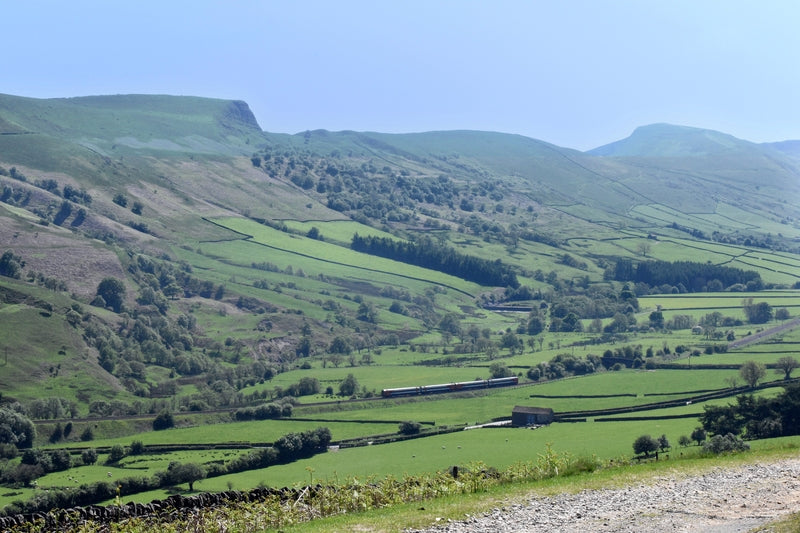
Photo: Looking over verdant fields in the Vale of Edale to the Great Ridge with Back Tor on the left and Mam Tor on the right, Norwich - Liverpool train passes. ID 380268846. © Amlyd. Dreamstime.com.