As any good Londoner knows, metro trains can be very small. Even a mere provincial like me knows the sardine-can 1995 stock on the Northern line, and Paris, Berlin and Glasgow run tiny trains too. Very few metros in Europe go narrower than the global standard, 1,435mm. When I think of narrow gauge railways, I think of mountains and rural Wales, not a commuter train. Yet five continental European cities ran proper, tunnelled metros on narrow gauge at some point in their history and most of these still do today: Stuttgart, San Sebastián, Naples, Valencia and Bielefeld . Why did they end up that way, and how have they managed these unusual railways in the modern day?
These railways were built privately. Their owners wanted to keep capital costs down and didn’t think much about long-term operations, and narrow gauge was cheaper to build. Underground the savings multiply, because the smaller the tunnel, the cheaper it is to bore. In the rapidly-urbanising Basque Country and Naples, harsh topography demanded extensive tunnelling. For today’s Donostia Metro, the old Spanish name Topo (mole in English) reflects that tunnelling.
The builders of the late 19th century couldn’t have known what came next. In Naples, Valencia, San Sebastián, Bielefeld and Stuttgart, industrialisation provoked growth in urban population. Lines that had been built as semi-rural railways, or partially as freight routes, now served bustling communities along them. As private control of railways gradually eroded throughout the early 20th century, these lines were increasingly taken over by the state. Today, any of these systems would be built to standard gauge, because operations are more efficient and cheaper.
Operating a narrow gauge metro is expensive and technically demanding, for two reasons. First, the trains are physically smaller, so they carry fewer people and need to run at a higher frequency to give the same throughput. Second, the trains are non-standard. Nearly all metros are standard gauge, usually with vehicles about 3 metres across, and the big manufacturers build those cheaply. Narrow gauge gets neither.
Each city coped differently.
Stuttgart did the most. It took its metre gauge tram system and gradually regauged the whole network over 22 years. Putting trams underground (some of these German Stadtbahns are an interesting blend of tram and train) wasn’t radical, since most West German cities did it and Stuttgart’s first city-centre tunnel opened in 1966. The regauging was radical: a third rail was laid outside the metre gauge pair. The first standard gauge Stadtbahn line opened in 1985. Dual gauge ran throughout until 2007, when the last metre gauge tram line was replaced by high-floor, standard gauge Stadtbahn vehicles. You can still see the three-rail track in a couple of places. The city-centre stations built in the 1960s also served low-floor trams for decades, which is why Stuttgart still has large cavernous stations with high-floor platforms at one end and low-floor platforms at the other.
Stuttgart could afford all this because, unlike the others, it was markedly rich. As demand has grown, it has doubled platform lengths across most of the underground network in the city centre. Long-term thinking by state authorities, taking risks to serve the city in the long run, is an about-turn from how the metre gauge tram system was originally built.
Though not as radical as Stuttgart’s 22-year regauging effort, Valencia used its narrow gauge urban railways as the feeder system for a new underground metro. FEVE, the Spanish state agency for narrow gauge railways, invested in the network after it took the lines over in the 1960s. In 1988, after the lines had passed to the regional government and its new operator FGV, a 6.7km tunnel opened, connecting two dead-end termini through the city centre with high-floor narrow gauge metro trains. The result feels like a proper metro in town and a regional railway at the edges, much like London’s Metropolitan line.
San Sebastián, 600km to the north of Valencia, has a similar railway history. After decades of private operation, the Topo began to physically collapse in 1972. The company went bankrupt and FEVE took over, as in Valencia, and the state paid for a complete modernisation, including new voltage and new trains. The system was still inefficient for a metro, with dozens of grade crossings and flat junctions, so after the Basque government took over in 1984 it was built up piece by piece. Four tunnels were built in the 1990s and 2000s, and the biggest piece of the puzzle is about to be put in place. In November, a new 4.2km tunnel will open through the centre, turning a line that terminates at Amara into a through-running east–west metro. Regauging, Stuttgart-style, was never an option, because the tunnels were too tight and already built. But new stretches of track have overcome the existing operational challenges, such as single-track sections, at very high cost.
The Circumvesuviana is a sprawling, infamous 140km network, bigger than anything else on this list. It uses the rare Italian “metre” gauge of 950mm which makes the buying of new rolling stock difficult, though change is coming. Its trains are ancient and graffitied, a symbol of the region’s decay. The solution here (though this is really a commuter system, especially at the outer edges) has been much like Donostia’s. Some single-track sections have been doubled, a new underground section opened in 2025, and more new stretches are to come to avoid the worst historic track. The new trains are, ironically, built in Valencia, and are only 50mm too narrow for that city’s own metro. Perhaps Naples is simply Donostia done much later because the money couldn’t be found. The system the Basque Country had in the late 80s and 90s is what Naples will get in two to three years, once these medium-sized track upgrades and new trains are finished.
Bielefeld is something of an outlier. Like other West German cities, it put its trams underground and upgraded them in the 1960s and 70s instead of building a full U-Bahn like Munich or Nuremberg. Its Stadtbahn is still metre gauge, with platforms built for trains 2.3 metres wide. So from 2011 the Vamos cars fitted a 2.3 metre wide platform but then bulge out above it, giving an odd upside-down-pentagon shape and a 2.65 metre wide interior. That doesn’t solve every narrow gauge problem, but it beats small trains without rebuilding the network.
Narrow gauge metros aren’t a design choice, they’re an inheritance, and the clever part is how each city has made the best of it. And next time you squeeze onto the Northern line at King’s Cross, remember it’s about 20mm narrower than a Bielefeld Vamos. Maybe that’s the real oddity.
The Summer 2026 edition of the European Rail Timetable is available in print and digital formats and is the perfect partner to our Rail Map Europe. Order here.
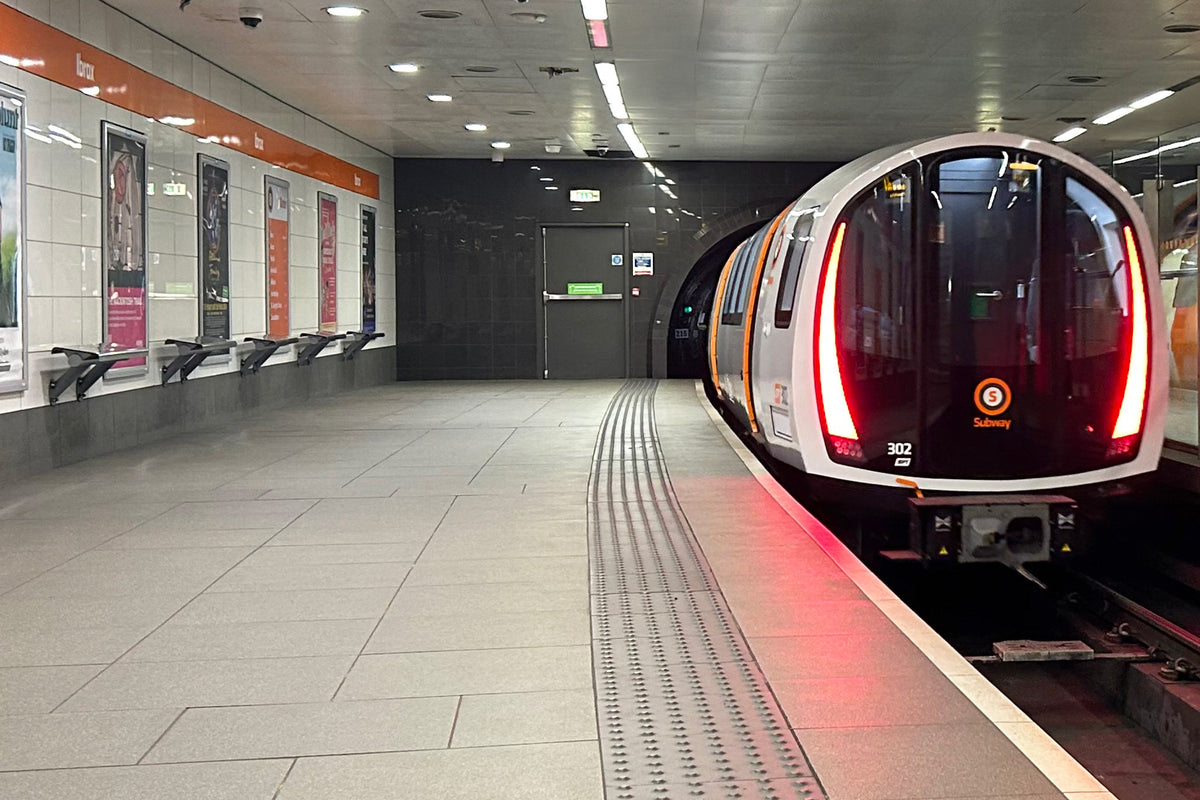
Image copyright and courtesy of Strathclyde Partnership for Transport.