
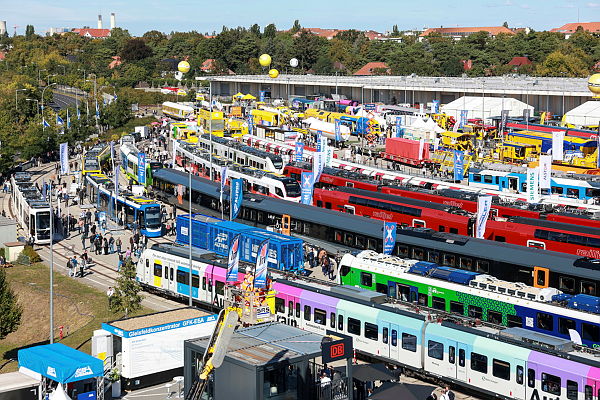
Berlin’s InnoTrans took place at the end of September in the city’s huge Messegelände. Enormous halls packed with stands from everyone from seat manufacturers to vegetation clearers, this is the rail industry’s biggest show. It largely exists as an opportunity for manufacturers and operators to come together, meet and do deals. That said, InnoTrans has always brought significant media and popular interest with it too.
I went this year and joined the crowds of rail professionals, journalists, bloggers, vloggers and rail enthusiasts in the hunt to understand what direction rail travel is going in over the next few years. Here are my five biggest takeaways (before a reflection on the show itself).
1. Night trains: the hype and the hard questions
With Nox’s punchy unveiling of its new carriages, night trains were again at the centre of media attention. Such was the well managed hype around the carriage that it was virtually impossible to see it unless you booked a slot. My best view came from the train on the opposite (wrong side?) track. Nox has gone hard with glitzy, millennial friendly marketing (shown by their collaborations with some of Germany’s cooler brands), and their business class-style seats have won many plaudits. It will however be interesting to see whether their extremely effective PR and marketing translates into bums on those seats in the months after the launch next year.
Elsewhere the main question around night trains revolved around profitability. Both Luna and a consortium called ALISA - largely funded by the German Aerospace Center - presented their concepts. Should ALISA’s train ever leave the research desk and become a real thing, it will be a stonkingly good product, combining comfort with solid economic thinking. However, at the moment, it feels a little too utopian to quite believe it can happen. Luna still feels like a more realistic prospect. The question here will be whether the clear focus on profit will work longer term and if they can really make their “pack them in” approach comfortable enough for travellers. Overall I was struck by how much thinking on night trains is coming from Germany at the moment. A belated nostalgic response to DB’s abandonment of their services? Or a serious attempt to reconnect across the continent by the most EU-friendly country in Europe?
2. Is comfort a competitive advantage?
The other trains shown could be split into two broad categories - those optimising for comfort and those for profit. ÖBB’s new Siemens Railjet is a major disappointment for fans of the operator’s fleet. This new 160km/h cross border Railjet gets (deliberately - I should add) closer and closer to a regional train and has some of the most uncomfortable seats I have sat on (especially in First Class). Competition - and we are mainly talking about Westbahn - in Austria is becoming more fierce and ÖBB clearly think their way to beat the market is to reduce price and therefore comfort as much as possible. A good example of how national carriers still look to their internal markets first before thinking about competition from abroad.
At the other end of the spectrum - and a company demonstrating different thinking - Trennitalia showed off the Frecciarossa trains with which they are going to enter the cross border market in the coming years. For passengers seeking comfort around Central Europe, it is hard to imagine DB or (all of) ÖBB being able to compete. In all their classes, these are excellently designed, comfortable trains. That said, the product itself is not really new and will be familiar to people who have travelled in Italy in the last few years. However, it is a sign that the Italians are leading the way on relatively affordable comfort around Europe at the moment. Norske tog’s Stadler-built Flirt Nordic Express may have a ludicrous name, but it is a genuine contender for the best looking passenger experience on a new train in Europe and may challenge Frecciarossa’s crown. The plush seats in the executive class are among the best I have seen. Beyond that there are clever touches all the way down the train. No other train has such a good kids’ compartment as this with a full climbing frame and games for kids to play on long journeys. Equally the dining car is about the best you can expect from a modern train. On top of this the small “workspaces” are the most generous I have seen on a newer train.
3. Workspaces: solving a problem nobody has?
The rise of these office spaces more generally is definitely still “in” for train manufacturers and operators. I may be the only person who quite regularly works on trains who does not fully understand this development - the cubicles are generally less comfortable and only really make sense if you wish to conduct video calls which in turn is far more dependent on operators ensuring their Wi-Fi is up to scratch than on the privacy of a poorly soundproofed sliding door. That said, if it convinces the people in suits that the railways are worth using we may all benefit. And who knows, they may start putting pressure on train companies to improve their Wi-Fi while they are at it!
4. A train when you want one
There were fewer truly whacky ideas at this year’s fair than some previous ones. That said, RailEvo’s concept for 24/7 rail taxis did strike me as very interesting. Whether or not it goes anywhere remains to be seen but they have backing from Trentino city authorities to experiment with the product in their home city. Should it ever become reality, it will be a death to timetables as people summon autonomously driven trains on their phones.
5. Who is rail really competing against?
The disruptors are here to stay. Whether it is Flixtrain’s sleek new Talgo carriages - a far cry from the ancient stock they inherited from Locomore at the start of their rail operations - or the sense that companies like ÖBB are adapting their offering in the face of competition (in this case from Westbahn), it is quite clear that some of the upstart rail companies have had enough success to change passenger experience and the industry more permanently. One question that persists here though is what is the real competition for rail companies? Is it other operators? Low cost airlines? Cars which can now be driven with a reasonably intact environmental conscience? Or people not travelling at all? How this question is answered is vital to developing new products and my sense is that there is little unity from within the industry about its greatest challengers.
This thinking about competition ended up informing how I felt as I left this dazzling show. Does the rail industry really think in the terms of its existing and potential passengers? The rail revolution has been much discussed but my sense is that firms tend to default to either an engineer’s or accountant’s perspective when looking for solutions to achieve it. There is nothing wrong with this per se. Companies need to make money and clever engineering solutions can help them do this. That said, my sense is that the passenger experience perspective risks getting lost in all of this. InnoTrans does not really exist for passengers, but the crowds of enthusiasts visiting it shows that it stands for more than just a classic trade fair in the rail industry. The 2028 edition is some way off, but I think they could do well to build in increased space to understand why people do and - perhaps more importantly - don’t travel by train in the first place.
The Summer 2026 edition of the European Rail Timetable is available in print and digital formats and is the perfect partner to our Rail Map Europe. Order here.
Image copyright and courtesy of Messe Berlin GmbH.

