Changing Gauge Without Changing Trains
There is a very simple rule in railway engineering: trains need rails, and the rails need to be the same distance apart. It sounds obvious, but across Europe that distance varies considerably. Much of the continent uses Stephenson’s standard gauge of 1,435 mm, but Spain and Portugal use 1,668 mm on their conventional networks, Switzerland has extensive metre-gauge railways, and most of the former Soviet states use 1,520 mm.
Usually, this doesn't matter. Trains stay on their own network, and everybody gets on with their day. It becomes rather more complicated when a train needs to cross from one gauge to another.
For most of railway history, the answer was fairly straightforward: whenever you had to change gauge, you had to change trains. People, luggage and goods all had to be transhipped from one set of stock to another. What a pain!
Then Spain came up with a rather clever alternative.
Spain
Spain's railway gauge presented a particular problem. Its 1,668 mm Iberian-gauge network was different from the 1,435 mm standard-gauge network used in France, meaning that international trains had to deal with a break of gauge at the French border.
In the 1960s, Spanish manufacturer Talgo developed a system that allowed the wheels of a train to move sideways so that their spacing could be changed while the train passed through a special gauge-changer.
The first experimental installation was built at Talgo's works at Aravaca near Madrid, where the system was tested in 1967. In November 1968, an experimental Talgo III RD travelled from Madrid to Paris without passengers having to change trains at the border. A few months later, the first commercial variable-gauge service began between Barcelona and Geneva.
The principle is remarkably ingenious. The train enters the gauge changer at low speed and the wheels are temporarily relieved of their load. Their locking mechanisms are released, and the wheels slide sideways from one gauge to the other before being locked into their new positions. The train then carries on.
It was a revolutionary development for international rail travel. Instead of unloading an entire train at the French border, the passengers could simply stay in their seats and continue their journey. The technology eventually became useful for something else, too.
When Spain opened its first high-speed railway between Madrid and Seville in 1992, it chose standard gauge for the new line. That created a new problem: how could the benefits of high-speed rail be extended to towns and cities still connected to the Iberian-gauge network? The answer was to build gauge changers at strategic points around the network.
Rather than changing trains, passengers could remain aboard a variable-gauge train. The train would use the new standard-gauge high-speed line for part of its journey, pass through a gauge changer, and continue along the conventional Iberian-gauge railway.
This became particularly important for Renfe's long-distance Alvia services. Variable-gauge trains have allowed services from Madrid to places such as Asturias, Galicia, the Basque Country and Santander to combine high-speed and conventional railway lines. The exact routes and services have changed over the years, but the principle remains the same: one train can use two different railway gauges during the same journey.
Spain now has gauge changers using both Talgo and CAF technology, with installations distributed around the network. What began as a solution to the international break of gauge has therefore become an important part of Spain's domestic railway system. And all of this is achieved by moving the wheels sideways.
Switzerland
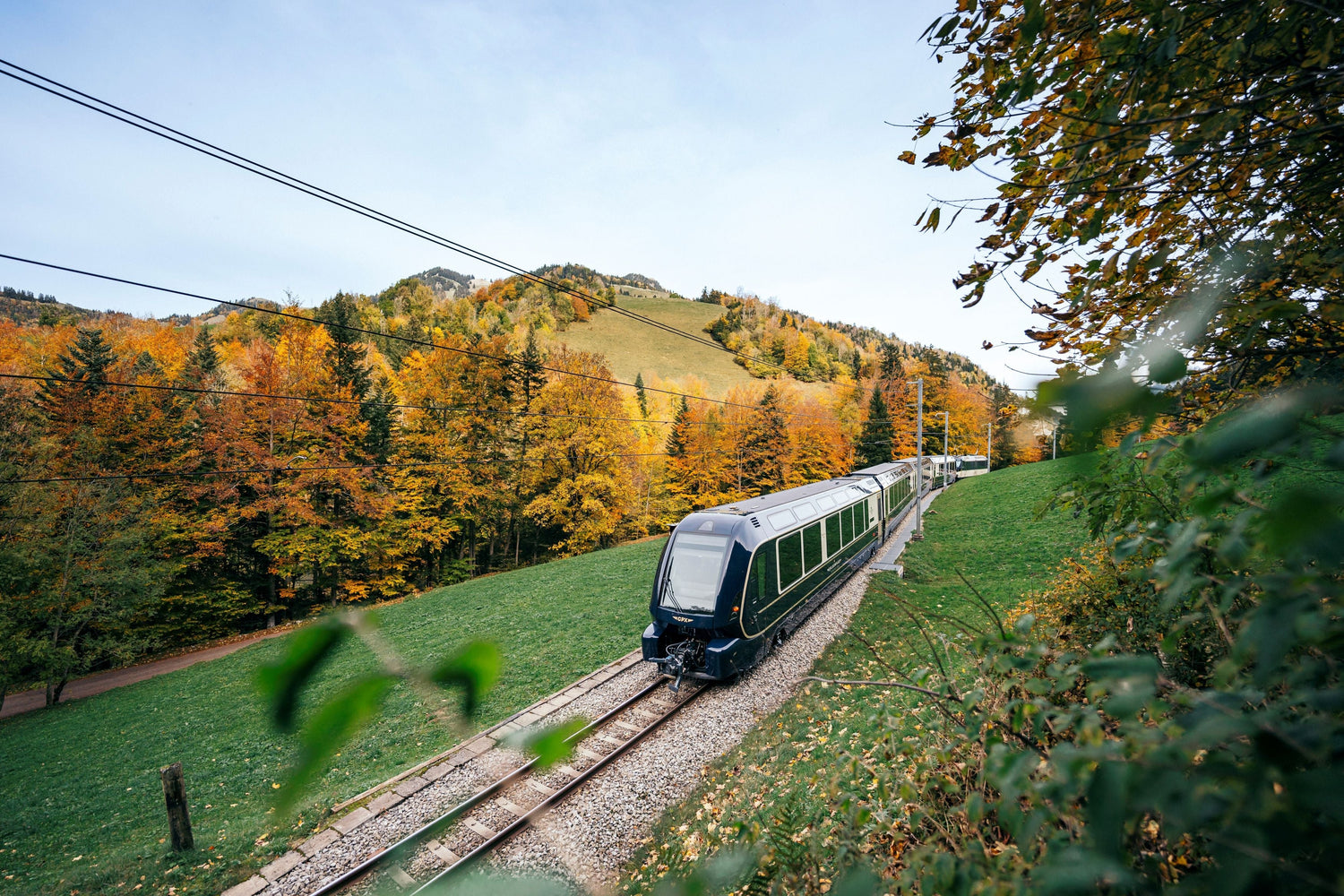
The GoldenPass Express between Montreux and Interlaken is another train that changes gauge without requiring passengers to change trains. But this time the starting point is metre gauge — 1,000 mm — and the destination is standard gauge, 1,435 mm. At first glance, that sounds like exactly the same problem as Spain. But it’s a bit more complicated.
The metre-gauge railway between Montreux and Zweisimmen has a more restrictive loading gauge than the standard-gauge railway beyond. The coaches therefore had to be designed so that they would fit on the narrower railway as well as being capable of changing gauge. Their variable-gauge bogies allow the wheels to move from 1,000 mm apart to 1,435 mm, while the coach body is also raised to match the different platform heights.
And there is another complication: the two railways use different electrical systems. The metre-gauge MOB line uses 900 V DC, while the standard-gauge BLS line uses 15 kV AC. The locomotives therefore cannot simply travel across the boundary with the coaches. At Zweisimmen, the MOB locomotive is replaced by a BLS locomotive.
The gauge changer itself is also rather different from the Spanish installations. It is in Zweisimmen station.
The GoldenPass Express arrives on the metre-gauge line, moves over the gauge-changing ramp at around 15 km/h and the wheels move outwards from 1,000 mm to 1,435 mm. At the same time, the coach body is raised by 200 mm. After the locomotive has been changed and the necessary checks completed, the train continues towards Interlaken. Incredibly, the whole process takes just eight minutes.
So, while Spain and Switzerland have both found ways of moving the wheels rather than changing them, the Swiss solution has had to overcome considerably more than just a difference in track gauge.
Eastern Europe
And then there is the more brute force solution. Ukraine uses 1,520 mm gauge, while Poland and Hungary use the 1,435 mm standard gauge. For some international passenger services, there is no need for clever variable-gauge technology. The coaches are simply lifted into the air on jacks and their bogies are changed!
The Kyiv Ekspres between Kyiv and Warsaw is one example. At the Ukrainian Polish border, the coaches are taken into a gauge-changing facility, lifted clear of their bogies and fitted with replacement bogies suitable for the Polish network.
The same basic principle is used by the Transcarpathia service between Kyiv and Budapest, with the bogies changed at Chop to allow the coaches to continue from Ukraine's broad gauge onto the standard-gauge Hungarian network.
It is not quite as elegant as a train quietly sliding its wheels into a new position as it rolls through a gauge changer, but it works.
And there is something rather satisfying about the sheer simplicity of the solution. No complicated variable-gauge mechanism is required under every coach. No special train is needed. When two railways don't agree on how far apart their rails should be, you lift the coach, take the old bogies away and put different ones underneath it. Passengers can even remain aboard while the work takes place.
Three ways to solve the same problem
The remarkable thing is that all three solutions achieve the same thing: they allow passengers to continue their journey even when the railway ahead has been built to a different gauge.
Spain uses technology developed to make the wheels adapt to the railway. Switzerland takes that idea a step further, combining gauge-changing with a coach designed to cope with the constraints of two very different railways. In Ukraine, the coaches themselves are lifted and given a different set of bogies.
There is no single right answer. Each solution reflects the railway it was designed for, the infrastructure it has to work with and the services it needs to provide.
The rails may not match, but the trains have found ways to get along.
The Summer 2026 edition of the European Rail Timetable is available NOW in print and digital formats and is the perfect partner to our Rail Map Europe. Order here.
Image: GoldenPass Express. Courtesy and copyright of MOB.