It may be a shock to some readers, but the European Rail Timetable sitting on your bookshelf is still, in large part, compiled manually. We use computers and digital tools throughout the production process, of course, but the actual timetable data is still entered and checked by people, through the slow process of reading national timetables and other railway information. That method has worked for more than 150 years, but the world around it has changed. Today, train companies can change their timetables with a few clicks. In an era before computers, GPS tracking and fast internet connections, once a timetable was printed, it had to be stuck to.
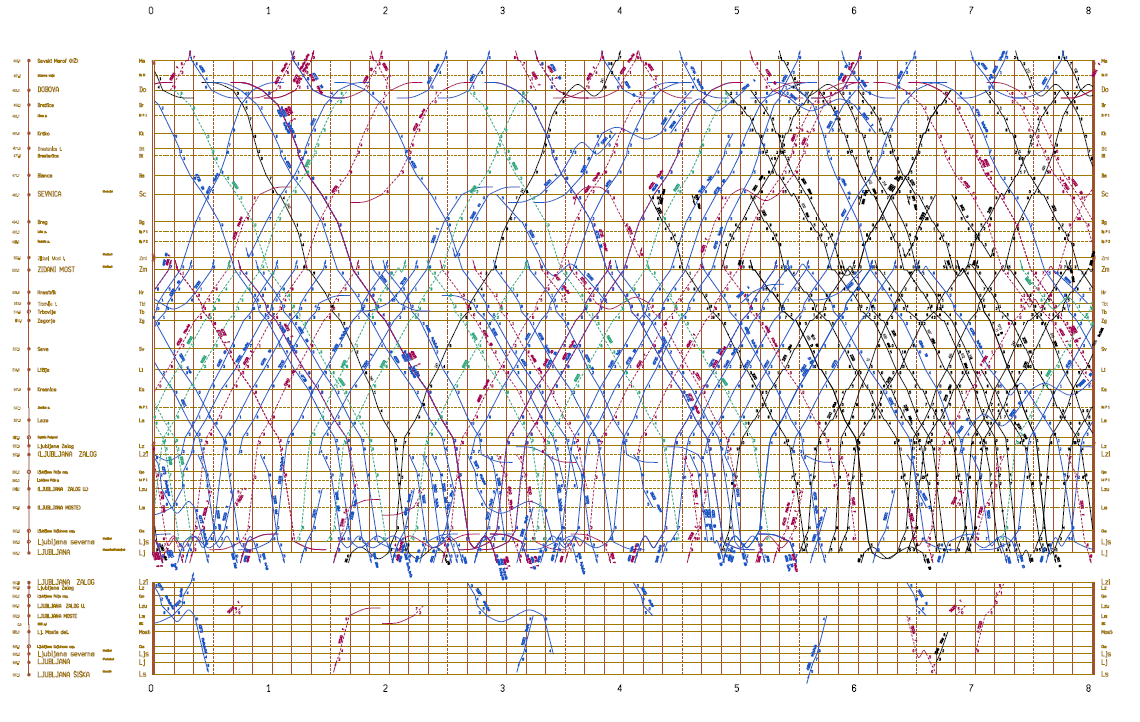
Before the timetable even reached the printer, there was a rather formidable piece of work: the train graph. Timetables were planned by drawing train paths by hand on large sheets of graph paper, with each line representing a train running along the railway. Move one train and you might have to move several others to make everything fit.
Thousands of copies might then have been sitting in stations, ticket offices, travel agencies and railway offices. Printed months in advance, they represented a rather expensive commitment. If the timetable said the train left at 10:42, then changing it to 10:47 wasn't simply a matter of changing a line in a database. Somebody had to print the new timetable. And then somebody had to distribute it.
That meant that railway companies had a very good reason to get their timetables sorted out well before they actually came into operation.
For a publication like the European Rail Timetable, this was rather useful. We could expect to start receiving advance information during the late summer for the December timetable change. By August or September, much of the new timetable would be sufficiently settled for us to start compiling the winter edition. There was still plenty of work to do, but there was also a deadline imposed by the physical world: the printer needed the files, and the finished books needed to be printed and distributed.
The internet changed all of this. And, as with so many things, it has been both a blessing and a curse.
The timetable that never quite finishes
Modern railway planning is vastly more flexible than it used to be. Operators have sophisticated computer systems for planning services, managing rolling stock and crews, and distributing timetable information. Changes can be made quickly and propagated through multiple systems without anyone having to reprint thousands of pages.
That's an enormous advantage when something genuinely needs to change. A line closes unexpectedly. Engineering work moves. A new train is added. The timetable can be changed without having to start again from scratch.
The problem is that the ability to change something easily has rather weakened the incentive to finish it.
The timetable can now remain a work in progress almost until the day it starts. For passengers, this isn't necessarily the improvement you might expect. In some countries it is difficult or impossible to book tickets four months ahead because the timetable simply isn't available that far in advance. And even where tickets can be bought several months ahead, there is no guarantee that the train will actually run at the time originally advertised.
You can therefore end up with the slightly absurd situation where technology allows a railway to publish information months in advance, but the passenger is effectively told not to rely on it.
The old-fashioned advantage of paper
There was something strangely useful about the limitations of paper. A printed timetable created a deadline, and once that deadline arrived there was a very good reason not to keep changing things.
Of course, timetables still changed. Engineering works, strikes, disruptions and operational changes have always happened. But there was a difference between changing a timetable and changing the timetable before it had even started.
Today, that distinction is much less clear. A railway can make a change because it has discovered something operationally necessary. It can also make a change simply because the planning process is still evolving. From the passenger's perspective, both can look exactly the same: the 10:42 has become the 10:47.
For anyone producing a printed timetable, however, the difference is particularly painful.
The strange lesson of digitisation
The irony is that the internet has made railway information simultaneously more accessible and less certain.
We can find a train's timetable from almost anywhere in the world in seconds. We can receive updates instantly. Operators can respond to changing circumstances far more quickly than they could in the past.
But passengers have also become accustomed to timetables that are provisional, booking windows that open surprisingly late, and journey times that can change after they've already bought their tickets.
The technology isn't the problem. The technology is doing exactly what it was designed to do. The question is whether, somewhere along the way, we've confused the ability to change something with the need to keep changing it.
Perhaps there was something to be said for the old-fashioned discipline imposed by the printing press.
The ERT problem
So why do we still produce a printed timetable when so much railway information is now available online? Because there is still something very useful about having the timetable in one place, in a form that doesn't depend on an internet connection, a website remaining available or a journey planner deciding what information to show you.
A printed timetable gives you the whole picture, rather than just the journey you happen to have searched for.
This is one of the reasons why producing the European Rail Timetable has become rather more challenging than it was in the past. We don't simply need a timetable. We need the timetable in a form that can be checked, edited, formatted and turned into thousands of lines of printed information.
Getting raw data isn't necessarily the same as getting usable data. Some railways provide excellent structured data. Others don't. Some publish information relatively early; others release useful information only shortly before the timetable starts. And increasingly, changes continue to arrive after we've started compiling the book.
At the same time, the physical production process hasn't magically become instantaneous. Our printers' lead times have roughly doubled in the last couple of years, while compiling the timetable remains, for the moment, a surprisingly manual process.
We're working on that. One of the projects we're particularly interested in is automating much more of the compilation process, using modern software to do some of the repetitive work that currently takes our small team a considerable amount of time.
If we can get that working properly, perhaps we can start clawing back some of the time that has disappeared from the timetable production cycle. Because we'd actually quite like to get back to the good old days.
Not necessarily because everything was better when timetables were printed on paper. It wasn't. But because when somebody had to print the timetable four months before it started, there was a very simple question that had to be answered:
“Is this actually the timetable?”
And the answer really did have to be yes.
The Summer 2026 edition of the European Rail Timetable is available NOW in print and digital formats and is the perfect partner to our Rail Map Europe. Order here.
Image: Slovenian train graph from 2010.