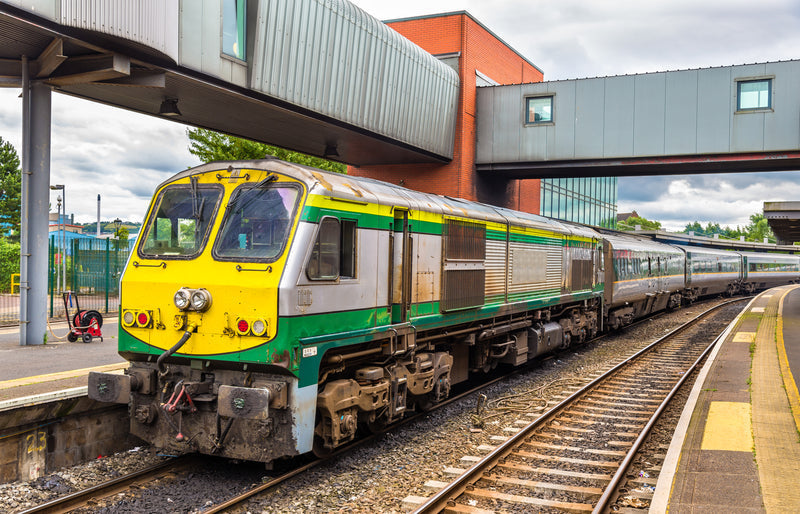
The Enterprise is known by rail tourists as a good, old-fashioned, ‘real’ train: loco-hauled, with a reasonable dining car and a proper First Class where you can get a cooked breakfast – it’s a window back to a more languid mode of train travel. Though not the most scenic of Irish Rail routes – we at ERT recommend Dublin to Killarney as the best scenic route in Ireland – it is, by and far, Ireland’s most important. But in the past week, this line has cemented its status.
Last week Belfast hosted its first-ever Fleadh Cheoil na hÉireann (Festival of Music of Ireland). The Fleadh, the world's biggest traditional music festival, had come to Northern Ireland for the first time. This unique celebration – of both traditionally-Unionist marching bands and Irish traditional music; strong symbols of cultural division – will be repeated next year, and is a miracle in itself noting the tragic history of the Troubles. The Fleadh is more a festival of great street busking (for free), live bands in pubs and talks on history; culture and language than a Glastonbury rave.
Bringing double the expected visitors and attracting hundreds of thousands by rail, the Enterprise played an unprecedented supporting role, suggesting that Irish rail tourism has entered a new phase. The Dublin-to-Belfast line carried many of the 1.8m visitors during the week of the Fleadh, so much so that musicians organised a ‘moving session’ of flute players, guitarists and fiddle players to serenade tourists north on their journey. On the Enterprise, live music was belted out to clapping and dancing in the aisles as the train rocked its way to Belfast's Grand Central Station.
It was probably the busiest season for Northern Ireland’s railways since the fifties. Of course, the ‘behind-the-scenes’ work to support a whopping 50% increase in ridership was significant. NI Railways and Irish Rail's success at pulling off the week without a hitch has won them good favour from government. The policymakers have listened.
Irish railways have always been seen as a risky bet for the government. Both North and South favour roads over rails. But the decision to double the train service to an hourly, Swiss-style clockface frequency in October 2024 has now been thoroughly justified. See European Rail Timetable Table 230 to see it for yourself. As we approach the two-year anniversary of that important upgrade, passenger numbers are up 40% – notwithstanding the Fleadh’s boom.
The €35m investment to bring the Enterprise to an hourly service snowballed into €1bn of future committed investment. As tourists flow out of Enterprise trains arriving in Belfast, politicians are beginning to pay heed to the fact that investment in railways is worthwhile. €700m will go towards new trains and track maintenance (eight new Stadler FLIRTs will replace the much-loved 1990s locomotives), and at least €1bn will be ploughed into the line – the latter permitting a four-track railway through densely populated suburban Dublin.
Capacity problems still abound for Irish Rail, and the prospects for other lines ERT readers might take look difficult. An important four-tracking and electrification scheme has been shelved for want of money, making journeys for tourists heading west to Cork or Killarney (Tables 244 and 245) slower. Money was ‘reprioritised’ from railways to regional road schemes. Despite this, Irish Rail had its best year in 2025, with 9% more passengers than in 2024 – versus 6% for Britain and 3% for Germany. My own recent trip to Westport (Table 240) was standing room only – despite the town having a population of just 7,000. If you’re heading to Ireland for a railway holiday in the dying days of August – or next year – reserving ahead is essential.
A final note on the Enterprise for those who have already bought the Summer 2026 edition of the European Rail Timetable (a worthy investment for any Friday Flyer reader, of course). On the top line of Table 230, the ‘E’ symbol shows the true Enterprise train – the loco-hauled sets with First Class and good catering. Take these trains if you can. The other trains operating the route are standard Irish Rail and NI Railways commuter trains. They’re still luxurious by London commuting standards, but far from the all-the-bells-and-whistles experience we recommend.
The Summer 2026 edition of the European Rail Timetable is available NOW in print and digital formats and is the perfect partner to our Rail Map Europe. Order at http://europeanrailtimetable.eu
Photo: ID 60093600 © Leonid Andronov. Dreamstime.com