Spain’s northern coastal railway represents a distinct case of structural, technical, and commercial fragmentation within what appears geographically to be a continuous corridor. Extending from Ferrol in Galicia to the French border at Hendaye, the route is unified by metre-gauge infrastructure but divided by governance, service models, and market function.
The defining structural change occurred in 2013 with the dissolution of FEVE. Its operations were absorbed into Renfe Operadora, while infrastructure was transferred to Adif. Both entities are wholly owned by the Spanish state, and the reform aligned the narrow-gauge network with the wider national model of vertically separated railway management, consistent with European Union policy. In commercial terms, former FEVE services were rebranded as Regional and appear on the Renfe website, signalling a shift away from any residual long-distance role towards a more regional and commuter bias.
Operationally, the corridor is characterised by the near-exclusive use of multiple units rather than locomotive-hauled trains. Diesel units dominate, but electric units are deployed in the more intensively trafficked areas of Asturias and Cantabria. The entire coastal route is metre gauge (1,000 mm), in contrast to Spain’s inland network, which is predominantly Iberian broad gauge and increasingly standard gauge on high-speed lines.
Since 2013, commercial development has been uneven. In Asturias and Cantabria, services have been integrated with existing broad-gauge Cercanías networks, with harmonised ticketing, regular interval timetables, and modest frequency improvements. These networks serve dense urban areas and function as genuine commuter systems, albeit still heavily subsidised under public service obligations.
In Galicia, on the other hand, the railway remains low-frequency and lightly used, reflecting difficult geography and limited demand. Here, the line functions primarily as a social service, with minimal commercial optimisation. East of Bilbao, operations transfer to Euskotren, which is owned by the Basque Government and operates as a vertically integrated regional railway. This section has seen more sustained investment since the 2000s, delivering higher frequencies, modern rolling stock, and strong integration with urban transport systems. The Bilbao–San Sebastián corridor now functions as a high-frequency regional railway, closer in character to a metro system than a conventional intercity line.
Bilbao represents a critical system boundary, where passengers must change operator—and typically ticketing system—at this point. The absence of a unified commercial proposition means that the corridor functions as three distinct markets: subsidised rural mobility in Galicia, integrated regional commuting in Asturias and Cantabria, and high-frequency regional transit in the Basque Country.
End-to-end journey times across the full coastal corridor are approximately 15 to 17 hours, reflecting low line speeds, lack of continuity, and the need to transfer between operators. As a result, the railway is not competitive as a through route and instead operates as a sequence of local and regional systems.
European Union investment has played only a limited role in the development of this corridor. While Spain has been a major recipient of EU rail funding, the overwhelming focus has been on high-speed and core TEN-T routes linking major cities via inland alignments. The northern coastal railway, with its low speeds and limited strategic freight role, has attracted only modest funding for incremental upgrades such as safety systems, electrification, and station improvements. A partial exception is the Basque Country, where regional policy and targeted investment have supported more substantial service enhancement.
At its eastern end, the corridor does connect physically with the French network. Euskotren services run through to Hendaye, where passengers can interchange with SNCF services, including regional and high-speed trains. However, this connection is not commercially integrated: ticketing, service planning, and passenger information remain separate, and the route is not marketed as a through corridor.
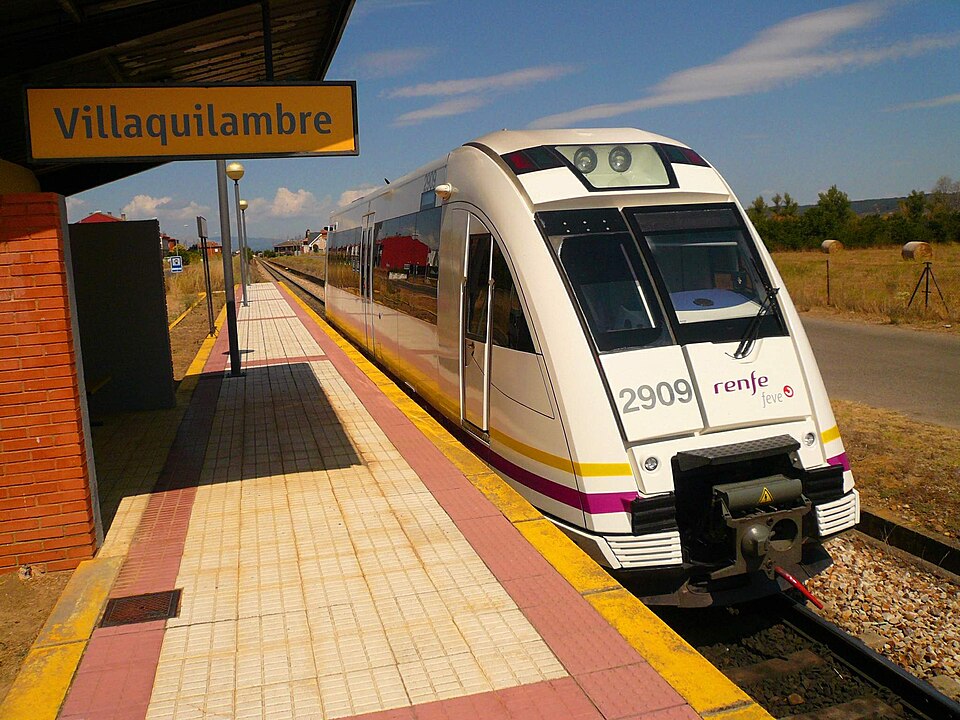
Photo: FEVE train at Apeadero de Villaquilambre. By Zarateman, CC0, via Wikimedia Commons.