A recent call from a customer reminded us just how powerful rail travel can be when it comes to meaningful journeys. They were ordering copies of the Spring European Rail Timetable to help plan a pilgrimage along the Camino de Santiago — and it set us thinking. Across Europe, some of the continent’s most important pilgrimage sites, past and present, remain wonderfully accessible by train, offering not just a route, but a journey in the truest sense.
Santiago de Compostela (Spain)
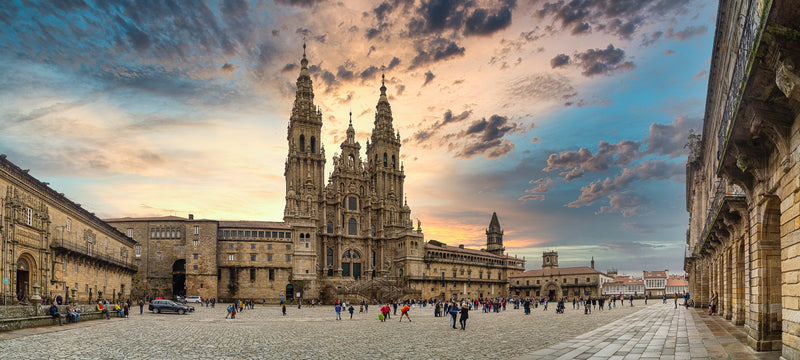
At the far north-western edge of Spain lies Santiago de Compostela Cathedral, the destination of the legendary Camino de Santiago. For centuries, pilgrims have made their way here to the shrine of St James, following a network of routes that span France, Spain and Portugal.
The most well-known path, the Camino Francés, threads its way from Saint Jean Pied de Port through Pamplona, Logroño, Burgos, León and Ponferrada before the final stretch into Santiago. Yet this is just one of many ways to arrive — the Camino is less a single route and more a web of journeys, each with its own rhythm and landscape.
Rail plays a key role in modern pilgrimages. Travellers can reach starting points such as Pamplona or León with ease or even arrive directly in Santiago itself. From there, many continue onward to Cape Finisterre — once thought by the Romans to be the “end of the world”.
ERT Table Numbers:
· Saint Jean Pied de Port – Bayonne: Table 299
· Bayonne – Hendaye: Table 305
· Hendaye – Irun: Table 689a
· Irun – Burgos – Valladolid: Table 689
· Valladolid – León: Table 681
· León – Santiago: Tables 682/680 (trains 626/625)
Lourdes (France)
Nestled in the foothills of the Pyrenees, Lourdes has been one of Europe’s foremost pilgrimage destinations since 1858, when Bernadette Soubirous reported visions of the Virgin Mary at the Grotto of Massabielle.
Today, millions visit the Sanctuary of Our Lady of Lourdes each year. Pilgrims gather at the grotto, light candles, and many seek the healing waters that have become central to Lourdes’ spiritual identity.
Railways have long supported this flow of visitors. Special pilgrimage trains still operate, including Italy’s “Treno dei Cammini – Lourdes”, run by Trenitalia’s tourist division. These services are designed with pilgrims in mind, offering space for luggage, a relaxed pace of travel, and direct connections from cities across Italy into the Pyrenees.
Perhaps most remarkable are the “Treni Bianchi”, organised in partnership with UNITALSI. These specially adapted trains include medical facilities, allowing assisted pilgrims to travel in comfort — a powerful reminder that the railway itself can be part of the pilgrimage experience.
ERT Table Numbers:
· Paris – Lourdes: Table 305
· Toulouse – Lourdes: Table 325
Fátima (Portugal)
In central Portugal, the town of Fátima has become one of the most important Catholic pilgrimage sites of the modern era. The events of 1917 — when three shepherd children reported apparitions of the Virgin Mary — transformed this quiet rural setting into a place of global devotion.
At the heart of it all lies the Sanctuary of Fátima, a vast complex that includes the Basilica of Our Lady of the Rosary, the Chapel of the Apparitions, and the immense Basilica of the Holy Trinity. Pilgrims gather here in their thousands, particularly on key anniversaries, filling the wide esplanade between the basilicas.
Although Fátima is not directly on the main railway network, it is served by Chão de Maçãs – Fátima station, approximately 20 km from the town. Pilgrims can reach the sanctuary via bus or taxi from the station, making the train a practical first step for those arriving from across Portugal. As with many pilgrimage destinations, the final leg of the journey forms part of the experience — a gradual transition from everyday travel into something more reflective.
ERT Table Numbers:
- Lisboa – Chão de Maçãs – Fátima – Porto: Table 690
Częstochowa (Poland)
In southern Poland, the Jasna Góra Monastery in Częstochowa is home to the Black Madonna, one of the most venerated icons in the Catholic world. For centuries, pilgrims have made the journey here to seek spiritual guidance, healing, and to honour the revered image of the Virgin Mary.
Railways play a central role in supporting this flow of pilgrims. Częstochowa is well connected to Warszawa, Kraków, and other major Polish cities, allowing thousands of faithful to arrive each year. The final approach from the station to the monastery forms part of the pilgrimage experience itself, with streets lined by pilgrims and visitors walking in quiet reflection.
ERT Table Numbers:
· Warszawa – Częstochowa – Wrocław: Table 1061
· Kraków – Częstochowa: Table 1080
Canterbury (United Kingdom)
Canterbury offers a link to one of Europe’s great medieval pilgrimages. At Canterbury Cathedral once stood the shrine of Thomas Becket, drawing pilgrims from across Christendom following his martyrdom in 1170.
The shrine itself, richly decorated and famed for miracles, was destroyed in 1538 during the Dissolution of the Monasteries under Henry VIII. Today, a simple candle marks the spot where it once stood — a quiet but powerful reminder of its former significance.
The journey to Canterbury was immortalised in The Canterbury Tales, where a group of pilgrims travel from London, sharing stories along the way. Modern travellers can follow in their footsteps far more quickly by rail, arriving in about an hour from the capital using a Southeastern high-speed service from London St Pancras — though the sense of history remains just as strong.
ERT Table Numbers:
· London – Canterbury: Tables 101 and 102
Unique Rail Connections
Not all pilgrimage destinations remain on the main line. In rural Norfolk, the village of Walsingham has not been connected to the national rail network since 1964 — yet it remains one of England’s most evocative pilgrimage sites.
Walsingham’s story stretches back to 1061, when, according to tradition, Lady Richeldis de Faverches experienced a vision of the Virgin Mary and was instructed to build a replica of the Holy House of Nazareth. This “Holy House” became the focus of the shrine of Our Lady of Walsingham, and by the Middle Ages the village had grown into one of the great pilgrimage centres of Europe, attracting royalty and commoners alike.
Like Canterbury, Walsingham’s shrine was destroyed during the Reformation under Henry VIII. Yet pilgrimage never entirely disappeared — and in the 20th century it returned in force. Today, both Catholic and Anglican shrines draw pilgrims throughout the year, many of whom still walk the final “Holy Mile” from the Slipper Chapel at Houghton St Giles.
Walsingham sits at one end of the Wells & Walsingham Light Railway, a 10¼‑inch gauge line running four miles to Wells-next-the-Sea through the Norfolk countryside, along the route of the former standard gauge railway. Steam-hauled trains offer a gentle, almost timeless approach to the village, where pilgrimage has been taking place for nearly a thousand years. The nearest main line station, King’s Lynn, provides the gateway for rail travellers, with onward buses taking about an hour and a quarter via Fakenham. Wells-next-the-Sea can also be reached directly by bus from King’s Lynn or Sheringham, linking the miniature railway to the wider national network.
ERT Table Numbers:
· London - King’s Lynn: Table 178
· Norwich - Sheringham: Table 203
On a very different scale, pilgrimage by rail also finds expression in Saudi Arabia with the Haramain High-Speed Railway. Connecting the Islamic holy cities of Mecca and Medina, this 449-kilometre line links millions of pilgrims to the two most sacred sites in Islam, while passing through Jeddah and the King Abdullah Economic City. A short 3.75-kilometre branch line also serves the King Abdulaziz International Airport in Jeddah.
The railway, inaugurated in 2018 after nearly a decade of construction, is the first high-speed line in the Middle East, reaching service speeds of 300 km/h (186 mph). Modern Talgo 350 trains provide rapid, air-conditioned travel across desert landscapes, shrinking what was once a long, demanding journey into a two-hour trip between Mecca and Medina. The line is designed to withstand extreme temperatures and includes extensive infrastructure: bridges, tunnels, overpasses, underpasses, and even camel crossings.
While the railway experienced challenges — including the 2019 fire at Al Sulimaniyah–Jeddah Station and a COVID-19 suspension of services — it has rapidly become a crucial artery for Hajj and Umrah pilgrims. The stations themselves are designed as iconic gateways, reflecting Islamic architectural traditions, with mosques, VIP lounges, and other facilities tailored to the needs of religious travellers.
In contrast to the quaint, narrow-gauge charm of Walsingham, the Haramain line represents a modern, high-capacity, ultra-fast route for millions of faithful, demonstrating how railways continue to shape the experience of pilgrimage in dramatically different ways, whether across a few miles of Norfolk countryside or hundreds of kilometres of Saudi desert.
Photo: Santiago de Compostela. ID 165925. Copyright Francisco Crusat. Dreamstime.com.