New high-speed line opens in Turkey
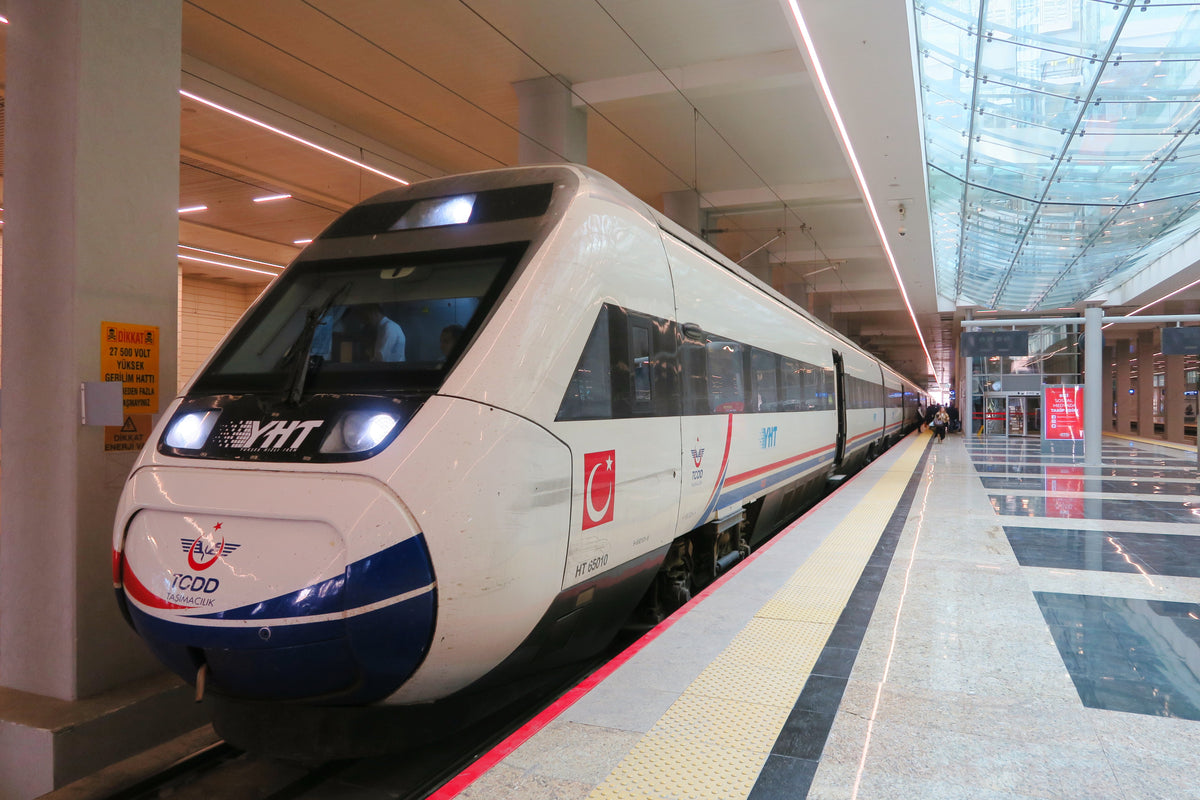
A new 153-kilometre section of high-speed railway has opened in north-western Turkey, extending the country's high-speed network towards the Bulgarian border. The Çerkezköy–Kapıkule section of the Halkalı–Kapıkule project was officially opened on October 9, with passenger services beginning the following day. The double-track, electrified line has been built for speeds of up to 200 km/h.
Three high-speed trains operate daily in each direction between Çerkezköy and Edirne, taking 54 minutes. Departures from Çerkezköy are at 10:45, 15:00 and 19:30, with return services from Edirne at 09:00, 13:00 and 17:45. Trains call at Büyükkarıştıran, Lüleburgaz and Babaeski.
Passengers travelling to or from Istanbul can connect at Çerkezköy with the existing regional service between Halkalı and Uzunköprü. This operates once daily in each direction, departing Halkalı at 08:25 and Uzunköprü at 15:40. The new high-speed services do not currently run to Kapıkule itself.
The line forms part of a 229-kilometre project intended to improve rail connections between Istanbul and the Bulgarian border. However, the remaining sections between Çerkezköy and Halkalı are still under construction, so the full route is not yet available for high-speed passenger services. Once completed, the project is intended to reduce the journey time between Halkalı, on the western edge of Istanbul, and Kapıkule from around four hours to one hour thirty minutes.
ÖBB previews 2027 timetable
ÖBB will introduce new international connections and expand selected long-distance services when the 2027 European timetable takes effect on December 13, 2026. The changes include additional Intercity trains in Austria, a new overnight ICE service to Germany and planned direct trains to Beograd. Major engineering works will affect routes to Germany via Salzburg and also services via the Tauern line between Schwarzach-St Veit and Villach.
From July 2027, three additional Intercity trains per day in each direction will operate between Graz and Linz. Combined with existing Interregio services, this will provide 11 direct trains per day in each direction. Additional Interregio services will also operate between Graz and Villach via the Koralm Railway, including early-morning and late-evening departures.
ICE services to Nürnberg, Frankfurt, Dortmund and Berlin will return with the timetable change on December 13, 2026, following completion of engineering works on the Passau–Nürnberg route. The return of services to Nürnberg will restore direct trains between Wien and the German city, with ten ICE services daily. An additional pair of ICE trains between Wien and Dortmund will improve early-morning and late-evening connections, while a new overnight ICE service will link Wien and Stuttgart.
From summer 2027, ÖBB, Deutsche Bahn and Trenitalia plan to introduce Frecciarossa high-speed trains on services from München via Innsbruck to Milano and Roma.
Direct trains between Austria and Beograd are also planned for 2027, the first such connection since 2019. Two trains per day in each direction are envisaged, with a journey time of around six hours thirty minutes. The launch date is dependent on approval for the route through Hungary.
Two new EuroCity services will link Wien with Košice via Bratislava and Žilina, whilst from summer 2027 RJX 765 will run from Bregenz through Wien to Bratislava, and RJX 168 will connect Bratislava with Zürich via Wien.
From mid-2027, new cross-border regional trains will link Innsbruck with Malles/Mals via Brenner, Bolzano/Bozen and Merano/Meran. Six new Coradia Stream trains will enable passengers to travel between North and South Tyrol without changing trains at the Austrian-Italian border.
Passengers travelling between Austria and western Europe will face significant disruption from February 8 to July 9, 2027. Engineering works will close the Deutsches Eck route between Freilassing and Rosenheim, while the Tauern line between Schwarzach-St. Veit and Mallnitz-Obervellach will also be completely closed for a second phase of tunnel and line refurbishment.
ÖBB and Deutsche Bahn are planning diversions and replacement services. RJX trains between Wien and München will be diverted via Passau, while journeys towards Tirol, Vorarlberg and Zürich may involve longer journey times or replacement buses.
DB adds ICE Sprinters and international services for 2027
Deutsche Bahn will introduce additional ICE Sprinter services and expand several international connections when its new timetable takes effect on December 13, 2026.
A new Hamburg–München ICE Sprinter will run three times daily in each direction, calling only at Hannover and Nürnberg. The journey will take five hours twenty minutes, around twenty minutes faster than at present. Berlin–Stuttgart Sprinter services will also increase from one to three daily in each direction, with a journey time of four hours forty-five minutes. Elsewhere, half-hourly services will return between Berlin and Hamburg following infrastructure restrictions. The Intercity service between Dresden, Berlin and Rostock will again run every two hours to Warnemünde, while Saarbrücken will gain its first direct long-distance connection to Hamburg. Jena will regain a direct Berlin connection, and East Westphalia will receive a daily direct service to München.
International services will also expand. Stuttgart–Paris will have twelve trains daily in each direction, two more than previously. Following completion of the Nürnberg–Passau upgrade, fourteen daily long-distance trains will connect Frankfurt, Nürnberg and Wien, also two more than before the engineering works. From March 2027, seven trains daily in each direction will operate between Hamburg and København, approximately every two hours from 7am. DB, ÖBB and Trenitalia are introducing Frecciarossa high-speed trains in Germany for the first time. From summer 2027, daily return services will connect München with Milano and Roma.
DB says its international network will offer more than 320 daily services, providing direct connections from Germany to over 200 cities in fourteen countries. Tickets from several European operators, including ÖBB, SBB, Trenitalia, SNCF, Eurostar, SJ and National Rail, are also becoming available through DB's website and app, opening up more than 10,000 additional destinations for booking.
Major engineering works will continue during 2027, including Hannover–Berlin, Hanau–Fulda and Rosenheim–Freilassing. During the Hannover–Berlin works, direct ICE services between North Rhine-Westphalia and Berlin will continue at least hourly, although journeys will take around eighty minutes longer.
The Summer 2026 edition of the European Rail Timetable is available in print and digital formats and is the perfect partner to our Rail Map Europe.
Photo: TCDD HT65000 train at Ankara by NicholasNCE - Own work, CC BY-SA 4.0.