Tauern Tunnel closure to disrupt Austrian rail services for five months in 2027
The Tauern Railway between Schwarzach-St. Veit and Mallnitz-Obervellach will close from February 8 to July 9, 2027, while ÖBB carries out the second stage of modernisation work on the Tauern Tunnel.
The closure will affect journeys between Salzburg and Carinthia, including international long-distance services using the route. The work will also see the Tauern Railway car shuttle modernised, with both projects scheduled to be completed during the same interruption.
ÖBB will provide replacement buses between Bischofshofen and Spittal-Millstättersee every hour, alongside a separate hourly replacement service between Schwarzach-St. Veit and Bad Gastein. Additional direct buses will operate between Bischofshofen and Villach, while a commuter shuttle will connect Bad Gastein with Mallnitz-Obervellach.
Long-distance trains between Mallnitz-Obervellach and Spittal-Millstättersee will operate every two hours during the closure, with some changes also required to services between Spittal-Millstättersee and Villach.
The disruption will also affect international night trains. The Stuttgart–Venezia Nightjet will be suspended from February 7 until July 9/10, 2027, while other night trains will be diverted via alternative routes.
The closure has been coordinated with Deutsche Bahn's planned closure of the Rosenheim–Freilassing route over the same period, allowing infrastructure work on both sides of the border to be carried out concurrently.
The Tauern Tunnel, which is 8.4 kilometres long, is an important part of the north–south railway route through the Austrian Alps. ÖBB plans to reopen the modernised tunnel and car shuttle on July 10, 2027.
Douro Valley line closed for five months of modernisation work
Services on Portugal's Linha do Douro (Douro Line) between Marco de Canaveses and Peso da Régua have been suspended from November 3, 2026 until March 24, 2027, to allow a second phase of major modernisation and electrification work.
The closure affects approximately 43 kilometres of the route, with passenger services replaced by buses operated by national railway company Comboios de Portugal (CP). Direct buses will operate between Caíde and Régua, while a second service will call at all stations between Marco de Canaveses and Régua.
The work forms part of a €110 million investment by infrastructure manager Infraestruturas de Portugal (IP) to modernise the section between Marco de Canaveses and Peso da Régua. The project, which began in 2025, is expected to take three years to complete and involves three separate periods of railway closures. The current interruption is the second of these.
The programme includes complete electrification of the route, renewal of track at seven stations, and the installation of electronic signalling, automatic train protection and GSM-R telecommunications systems. Work will also take place on six tunnels, involving structural reinforcement, waterproofing and lowering of the track bed to provide sufficient clearance for overhead electrification equipment.
Further improvements include stabilisation work on 40 embankments and cuttings, upgrades to station platforms and passenger facilities, and a substantial redevelopment of Régua station. The latter will include improved accessibility and a new pedestrian underpass connecting the platforms.
Electrification of the Douro Line has already been completed as far as Marco de Canaveses. Once the remaining section to Régua is modernised, the project is expected to reduce journey times and operating emissions, improve reliability and safety, and allow additional passenger services to be introduced.
The winter closure has been scheduled to minimise disruption during a period of traditionally lower passenger and tourist demand.
The Summer 2026 edition of the European Rail Timetable is available in print and digital formats and is the perfect partner to our Rail Map Europe.
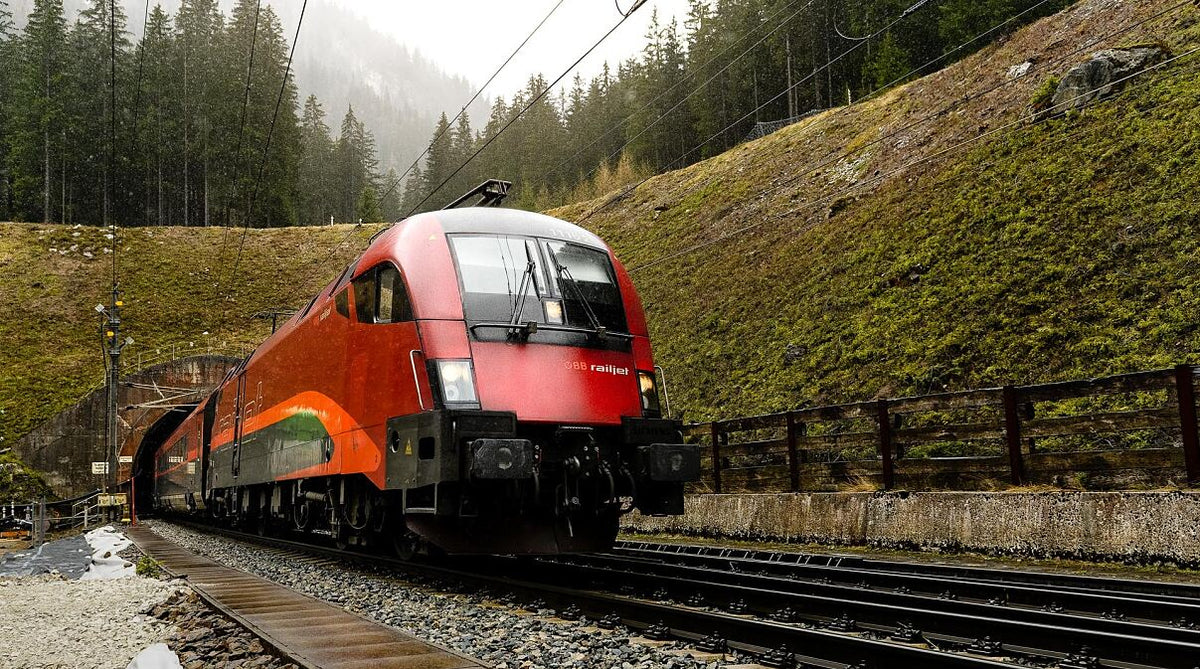
Image copyright and courtesy of ÖBB Marktl Photography.