Open-access operator targets Finland's overnight rail market
A new partnership has unveiled plans to introduce open-access overnight trains in Finland, potentially bringing a new competitor to the country's overnight rail journey market.
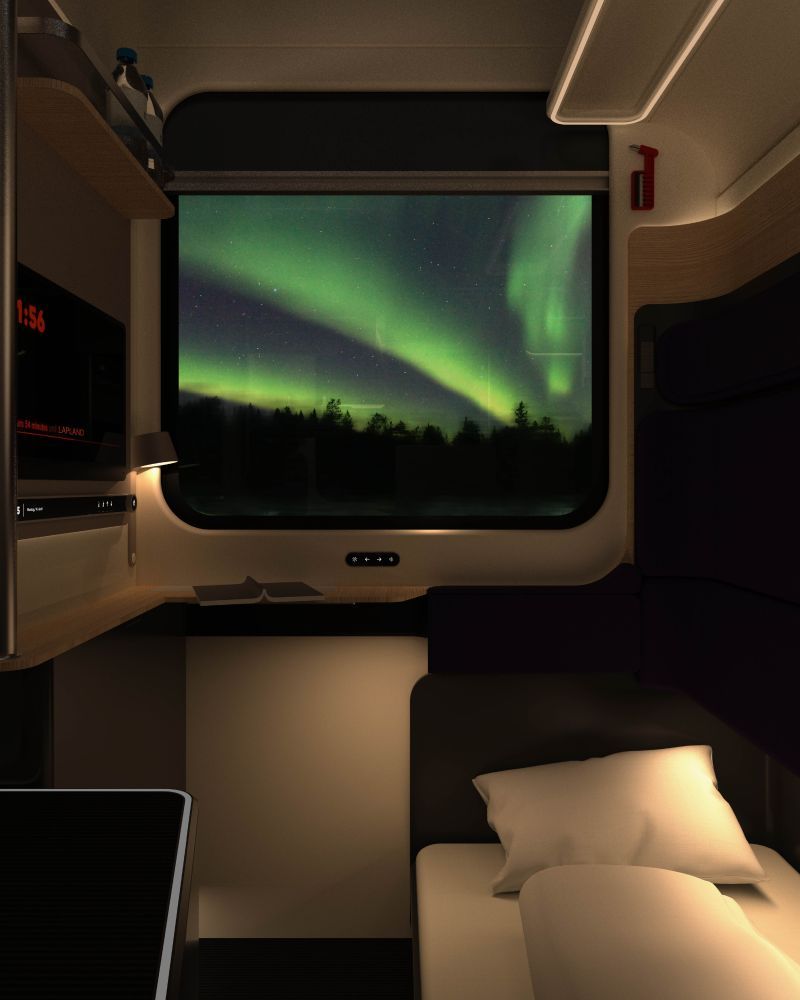
Finnish company Reissujuna and German start-up Luna Rail say they intend to develop a premium overnight service linking Helsinki with Lapland, a route where demand for sleeping accommodation regularly outstrips supply during the winter season. The proposal would make use of refurbished passenger coaches fitted with newly designed cabin interiors, offering a higher level of privacy and comfort than traditional couchette accommodation.
The companies also envisage using the same rolling stock on daytime services, allowing the trains to earn revenue throughout the day before being converted for overnight operation.
While the announcement is an interesting development for Finland's rail market, the project remains at an early stage. No launch date has been announced, and key details such as the timetable, operating arrangements and route access have yet to be confirmed.
The announcement marks the first step towards a potential new open-access overnight operator in Finland. However, with no launch date or operating details yet confirmed, the project remains firmly at the development stage.
Image courtesy of Luna Rail.
New trains to remove Brenner border change from mid-2027
Passengers travelling between Austria and Italy via the Brenner Pass should be able to make regional journeys without changing trains from mid-2027, thanks to the introduction of new cross-border services.
The new trains will operate between Innsbruck and Malles/Mals via Brenner, Bolzano/Bozen and Merano/Meran, creating a direct regional connection between North and South Tyrol.
At present, passengers travelling across the Brenner border by regional train need to change at Brenner, largely because Austria and Italy use different railway electrification systems. The introduction of new multi-system trains will remove this interruption, allowing passengers to remain on board for the entire journey.
The new trains are being jointly acquired by the authorities in Tyrol and South Tyrol and will be capable of operating under both Austrian and Italian power systems. Although trains will still stop at Brenner for operational reasons, including a change of train crew, passengers will no longer need to change trains.
The direct services will make travel easier for commuters and residents on both sides of the border, while also improving options for visitors exploring the Alpine region.
The new regional services are expected to begin with the mid-2027 timetable change, ahead of further developments on the Brenner corridor, including the future opening of the Brenner Base Tunnel, which will transform long-distance passenger and freight routes through the Alps.
Working group to examine Caledonian Sleeper links to mainland Europe
The Scottish Government has established a working group to oversee a feasibility study into the possibility of extending Caledonian Sleeper services to mainland Europe.
The group, comprising representatives from Transport Scotland, Scottish Rail Holdings and Caledonian Sleeper, has been tasked with producing a high-level assessment of the technical and commercial challenges involved in operating direct sleeper trains beyond the UK. Its findings are expected later this year.
The proposal remains at a very early stage and no routes, destinations or timetable have been announced. Instead, the study will examine whether such services could be practical and commercially viable.
While the concept may appeal to travellers looking for a lower-carbon alternative to flying, launching an international sleeper from Scotland would present a series of significant challenges. Any operator would need access to the Channel Tunnel, rolling stock capable of operating in several countries, safety certification across multiple national rail networks, border and security arrangements, international operating agreements, facilities to stable and maintain the trains, and a business case capable of competing with airlines and existing daytime rail services.
Journey times would also be a major consideration. Even a service between Edinburgh and Paris would take considerably longer than existing daytime rail or air travel, making the market for such a train far from straightforward.
The Scottish Government said the working group marks the first step in fulfilling a manifesto commitment to examine the potential for sleeper services to mainland Europe. Ministers say the study is intended to establish the practical, technical and commercial considerations before any decisions are taken.
At this stage, however, the announcement represents the beginning of a feasibility exercise rather than a commitment to introduce international sleeper services. If the project were ever to progress beyond the study phase, it would almost certainly require close cooperation with infrastructure managers, governments and railway operators across several countries.
Tortoise rescued after wandering onto West Coast Main Line
Rail staff came to the rescue of an unexpected trespasser after a tortoise wandered onto the West Coast Main Line at Runcorn.
The reptile, believed to be around 50 years old, was spotted making its way along the tracks by a passenger waiting on the station platform. Train services were briefly halted while staff from Avanti West Coast and Network Rail safely recovered the animal.
The rescue took around ten minutes, after which services resumed and the tortoise was taken to a local rescue centre for a health check. It was reunited with its owner the following day.
Avanti West Coast praised the quick response of station staff and Network Rail colleagues, saying the incident was resolved safely while keeping disruption to passengers to a minimum.
Although incidents involving animals on the railway are not uncommon, they usually involve livestock or wildlife. A tortoise on one of Britain's busiest main lines is certainly a rarer sight.
The Summer 2026 edition of the European Rail Timetable is available NOW in print and digital formats and is the perfect partner to our Rail Map Europe.