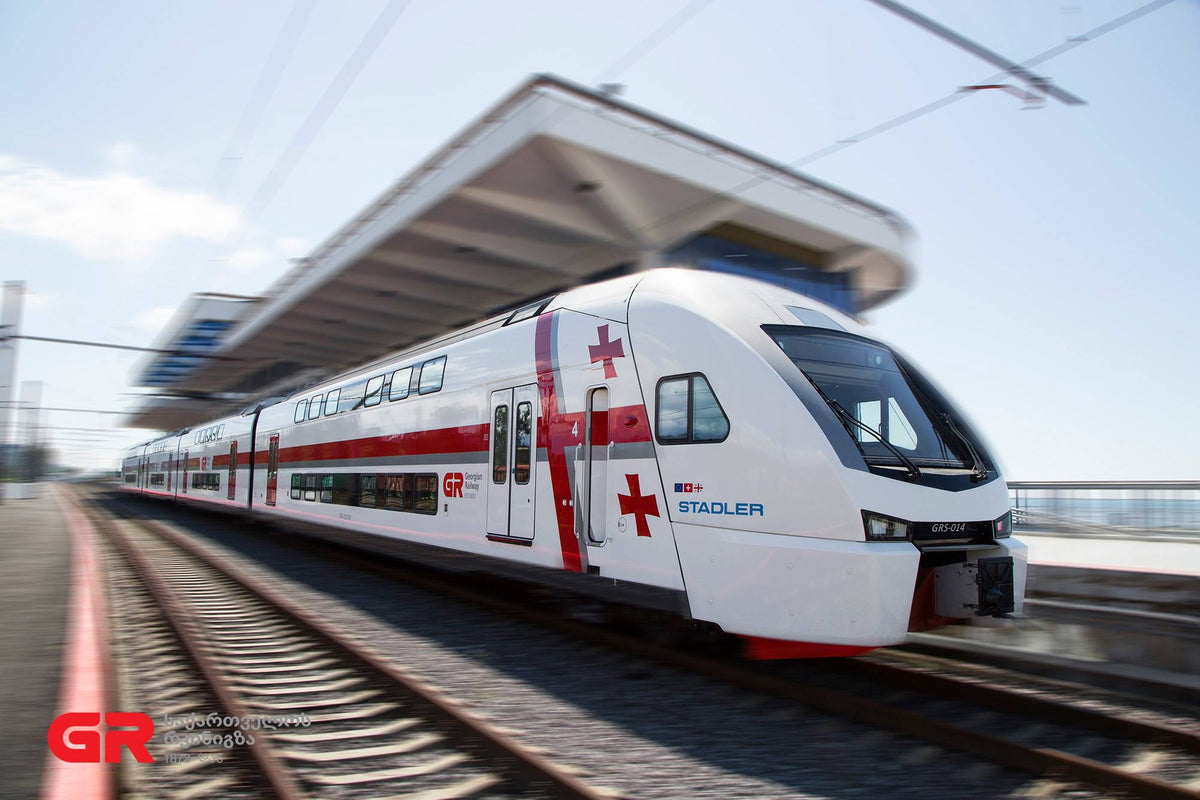
Georgian Railway cuts Tbilisi–Batumi journey time to four hours
Georgian Railway has reduced the journey time between Tbilisi and Batumi to four hours, following infrastructure improvements and the removal of speed restrictions on the route.
The reduction has been made possible by extensive work on the railway between the Georgian capital and the Black Sea coast. Georgian Railway says the track on the route has undergone complete rehabilitation, while protective fencing has been installed at locations identified as requiring additional safety measures.
The completion of a modernisation project on the pass section of the route has also allowed trains to operate at higher speeds, contributing to the shorter journey time.
The Tbilisi–Batumi route is one of Georgia's most important passenger railway services, linking the capital with the country's principal Black Sea resort and port. Cutting the journey to four hours makes rail a more attractive option for travel between the two cities.
Infrastructure improvements are continuing at stations along the route. Rehabilitation has already been completed at Ureki, Khashuri and Zestaponi, while work is currently under way at Kobuleti, Poti and Samtredia.
Further station projects are planned at Lanchkhuti, Natanebi, Ozurgeti, Khobi, Gori and Kutaisi, while work on the platform at Zestafoni is due to begin at the end of August.
The improvements are not limited to infrastructure. Georgian Railway says that five passenger trains are currently undergoing overhaul, while procurement procedures have begun for 10 new passenger trains.
Once the rolling-stock renewal programme is complete, Georgian Railway says it intends to introduce additional services and destinations, potentially giving passengers more options beyond the current network.
For now, however, the headline improvement is already being delivered: passengers travelling between Tbilisi and Batumi can now make the journey in four hours, thanks to the combination of track rehabilitation, infrastructure modernisation and higher permitted speeds.
European Sleeper and RDC plan new Brussels–Scandinavia night train
European Sleeper and German railway operator RDC have announced plans for a new night train linking Brussels and Amsterdam with København and Malmö, targeted to begin operating in April 2028.
The new service will be European Sleeper's first route into Scandinavia, creating a direct overnight connection between the Benelux, Denmark and southern Sweden. Current plans envisage departures from Brussels and Malmö at around 19:00, with arrival at the other end of the route at around 10:00 the following morning. The timetable is still being developed, with the formal capacity application due in April 2027. The train is expected to offer seats, couchettes and sleeper compartments, with deluxe sleeper accommodation, potentially including double beds and private en-suite bathrooms, also under consideration.
The partnership is particularly interesting because RDC is about to take over operation of the Berlin–Stockholm EuroNight service, while also already providing rolling stock for European Sleeper's existing Paris and Milan services. The announcement says the new Brussels–Malmö service will use night-train accommodation from European Sleeper and RDC but does not specify which vehicles will form the trains.
With the Berlin–Stockholm operation and the new Brussels–Malmö service both involving RDC, could some of the same rolling stock eventually find its way onto the new route? We don't know yet — but it's certainly something we'll be watching as the plans develop.
European Sleeper is also preparing a Brussels–Barcelona service for 2028, following the launch of its Brussels–Milan service next month.
Could Madrid–Lisbon trains be about to return?
Reports in the Spanish media suggest that a direct rail service between Madrid and Lisbon could be about to return – with two very different possibilities involving Renfe and CP.
The first is from unofficial sources. Spanish rail publication Trenvista says that Renfe and Portuguese operator CP are working on a daytime Intercity train between Madrid and Lisbon, the second is to use Series 106 and 107 high-speed trains between Madrid and Lisbon, both services running via Badajoz and using the new Évora–Elvas railway in Portugal.
According to the report, the service would use Talgo VI coaches, hauled by a Renfe Class 334 locomotive between Madrid and Badajoz, with a CP Class 5600 taking over for the journey into Lisbon. The new Évora–Elvas line is currently being tested at up to 200 km/h.
If it were to happen, it would restore a direct Madrid–Lisbon train for the first time since the Lusitania Trenhotel was withdrawn in March 2020.
There is also another possibility, and this one has been publicly announced.
On 18 August, Spanish Transport Minister Óscar Puente told Europa Press that Renfe is attempting to homologate its Series 106 and 107 high-speed trains for operation in Portugal. Puente said the trains are well suited to the Portuguese network and that Renfe is changing its international expansion plans to focus more heavily on Portugal following difficulties expanding in France.
Spanish reports have subsequently identified Madrid–Lisbon via Badajoz as one of the international connections envisaged as Renfe expands into Portugal, alongside a Vigo–Porto service. The Spanish and Portuguese governments are aiming to have their cross-border high-speed connections in place by 2030.
Seasonal trains to Bar extended due to strong demand
The seasonal international trains between Serbia and Montenegro will continue operating into the autumn following strong passenger demand, with Srbijavoz extending both the daytime Tara, and the overnight Lovćen services.
The Tara between Subotica and Bar will now operate until the end of September. Train 1131 will run from Subotica to Bar until September 30, while the return train, 1130 will operate from Bar to Subotica until October 1.
The train leaves Subotica at 08:04, calling at Petrovaradin at 08:56 and Beograd Centar at 09:37 before continuing south through Serbia and Montenegro to reach Bar at 21:10. The return service leaves Bar at 09:00 and reaches Subotica at 21:55.
The extension also means that several domestic services will retain their summer timetable for a little longer. Inter Regio trains 615 and 616 between Petrovaradin and Užice, and Regio trains 2120 and 2121 between Beograd and Priboj, will have their operating calendars adjusted accordingly from the beginning of October.
The international overnight Lovćen service between Beograd and Bar is also being extended. Train 433 from Beograd to Bar will continue operating in its summer configuration until September 30, with the return train 432 continuing in its summer formation until October 1.
The extensions come as Srbijavoz reports strong interest in the services, and passengers are being advised to plan their journeys and purchase tickets in advance.
The continuation of the trains into the autumn provides a little more time to enjoy the direct rail connection between Serbia and the Montenegrin coast before the summer timetable finally comes to an end.
The Summer 2026 edition of the European Rail Timetable is available NOW in print and digital formats and is the perfect partner to our Rail Map Europe.
Image courtesy of Georgia Railways.