Charing Cross and Waterloo East reopen on schedule
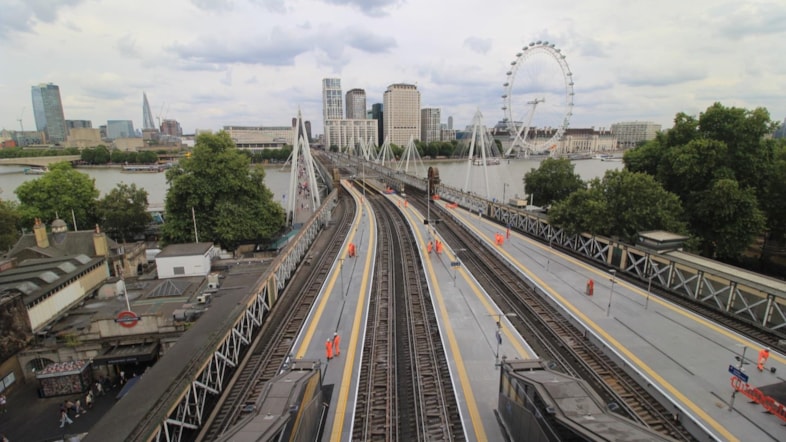
London Charing Cross and Waterloo East stations have reopened following a 22-day closure for a £20 million programme of railway engineering work.
The two stations closed on July 26 while Network Rail carried out a concentrated programme of work between Charing Cross and London Bridge. Southeastern services were diverted to other London terminals during the blockade, with passengers returning to Charing Cross and Waterloo East on August 17.
The main focus of the work was the replacement of almost two kilometres of track and 16 sets of switches and crossings. The track dated from 1990 and had become increasingly prone to faults, with problems on the section between Charing Cross and London Bridge responsible for more than 21,000 minutes of passenger delays.
The closure also allowed engineers to carry out work that would have been considerably more difficult with trains running. Sections of all six platforms at Charing Cross were rebuilt, while drainage was improved at Waterloo East.
Further work was carried out on the 175-year-old Hungerford Bridge, including the replacement of timber track supports and repairs to its steelwork. The footbridge at Waterloo East has also been refurbished, including new self-cleaning glass windows.
Rather than spreading the work over months of weekend closures, Network Rail and Southeastern opted for a single 22-day blockade. The alternative would have required around 60 weekend closures or four separate nine-day blockades.
The timing was also deliberate. The work took place during the summer holidays, when passenger numbers are around 20% lower than during the rest of the year, reducing the number of people affected by the closure.
There is still a little more work to come, with a further closure planned for August 23 for follow-up engineering work. The main programme is now complete, however, and Charing Cross and Waterloo East have reopened as planned — bringing an end to three weeks of disruption for passengers.
Image courtesy of Southeastern Railway.
Renfe changes Barcelona–Málaga and Barcelona–Granada AVE timings
Renfe is changing the timetable of four AVE services between Barcelona, Málaga and Granada from September 14, 2026. The current Barcelona–Granada train, which leaves Barcelona Sants at 08:30, will instead depart at 15:41, arriving in Granada at 23:13. The return service will move in the opposite direction, with its departure from Granada changing from 15:35 to 07:55, arriving in Barcelona at 14:54. Meanwhile, the Barcelona–Málaga service currently departing Barcelona at 15:41 will move to 08:30, arriving in Málaga at 15:11. The return train will move from a morning departure at 08:22 to 15:50, reaching Barcelona at 22:59. In other words, the two services are effectively being rearranged to provide different departure windows for each destination.
Renfe says the changes are designed to increase the availability of seats during periods of higher demand while maintaining the current number of connections. Passengers who have already booked one of the affected trains will be contacted and offered alternatives, changes or cancellation without charge.
For anyone planning a journey between Barcelona and Andalucía, however, the changes are rather more significant than the modest description of a timetable adjustment might suggest. A journey that currently starts in the morning could soon require an afternoon departure, while the corresponding return journey moves in the opposite direction.
The new timetable comes into effect on September 14, 2026. Passengers should check the timetable when booking, particularly if they have previously travelled on these services and are expecting the same departure times.
Cable fire causes major disruption at Wien Praterstern
A cable fire at Wien Praterstern has caused major disruption to rail services in the Austrian capital, with around 20 kilometres of cable needing to be replaced.
The fire, which broke out during the night of August 13, caused extensive damage to ÖBB's technical systems, including cables supplying signalling, telematics and overhead line equipment. Rail services on the Wien S-Bahn main line and airport route have been severely affected.
ÖBB has introduced an emergency timetable while repairs continue. No trains can currently operate between Wien Praterstern and Wien Hbf, meaning services from the south are terminating or starting at Wien Hbf or, in some cases, Wien Meidling.
The damage is particularly unfortunate because the affected section was already due to close from September 7 as part of the major upgrade of the Wien S-Bahn main line. ÖBB says repairs are expected to continue at least until that planned closure begins, meaning parts of the construction timetable have effectively been brought forward.
The disruption has also affected the City Airport Train (CAT) service, which cannot currently operate by rail. A direct replacement bus service is running between Wien Mitte and Wien Flughafen for CAT passengers.
CAT had already announced that it would replace its trains with premium buses during the planned main-line closure from September 7, with up to five buses per hour in each direction between Wien Mitte and Wien Flughafen. Following the fire, however, the bus operation has been brought forward.
CAT says that from August 24 it will operate up to five buses per hour between the airport and city centre during the daytime, with a journey every 12 minutes between 7am and 7pm and every 15 minutes outside those hours.
The fire therefore means that passengers are getting an early taste of the arrangements that were due to come into force in September — although with the rather less welcome addition of a major emergency repair operation.
ÖBB tickets are being accepted on Wiener Linien services, while rail replacement buses are operating on the affected routes. Wien Flughafen remains accessible by rail via Wien Hbf, as well as by the airport bus.
ÖBB is advising passengers to allow additional time for their journeys and to check current services before travelling.
FS Treni Turistici Italiani reportedly facing closure
FS Treni Turistici Italiani, the Ferrovie dello Stato Italiane company created to develop tourist and heritage rail travel, could be heading for the end of the line less than three years after it was established.
Italian media are reporting that the company is facing heavy financial losses, and that FS is considering disbanding the subsidiary. The reports have not, however, been accompanied by an announcement from FS confirming that the company is to close.
FS Treni Turistici Italiani was established in 2023 with the aim of developing a dedicated range of tourist rail products, combining train travel with the promotion of destinations around Italy. Its services include both regular rolling stock operated as tourist trains and historic trains using heritage vehicles.
The company's first train, the Espresso Cadore, operated from Rome to Calalzo di Cadore in December 2023, with onward connections by road to Cortina d'Ampezzo. Since then, the company has developed a range of seasonal services aimed at leisure travellers, including overnight and daytime trains serving tourist destinations.
The concept is an attractive one: rather than simply providing transport between two cities, the train itself becomes part of the holiday experience. FS Treni Turistici Italiani has also sought to develop products incorporating bicycles, cars and motorcycles, as well as wider tourism packages.
But attractive products do not necessarily make attractive accounts.
According to reports in the Italian financial press, the company's financial performance has been poor enough to prompt FS to consider what to do with the business. The reported losses raise questions about how far a state-owned railway group should go in operating specialist tourist services commercially, particularly when those services are necessarily more seasonal and expensive to operate than conventional passenger trains.
That does not necessarily mean the trains themselves will disappear. If FS does decide to wind up the separate company, its activities and services could potentially be transferred elsewhere within the FS Group rather than simply abandoned.
For the moment, therefore, the story is less about the immediate disappearance of Italy's tourist trains and more about the future of the organisation created to develop them.
That is worth watching. FS Treni Turistici Italiani is a relatively young experiment in treating rail travel itself as part of the tourist attraction. Whether that concept can be made to work as a sustainable commercial operation may now be facing a rather important test.
The Summer 2026 edition of the European Rail Timetable is available NOW in print and digital formats and is the perfect partner to our Rail Map Europe.