Tbilisi–Baku sleeper train returns after six-year suspension
International passenger rail services between Tbilisi and Baku resumed today, restoring a key South Caucasus rail link after a six-year suspension caused by the COVID-19 pandemic. The overnight service restarted on May 26 following an agreement between the governments of Georgia and Azerbaijan reached during high-level talks in Baku earlier this month.
The return of the daily train marks the first regular passenger rail connection between the two countries since 2020. Georgian and Azerbaijani officials described the relaunch as an important step for regional connectivity, tourism and economic cooperation. The agreement was signed alongside a protocol confirming the full operational status of the upgraded Baku–Tbilisi–Kars railway corridor.
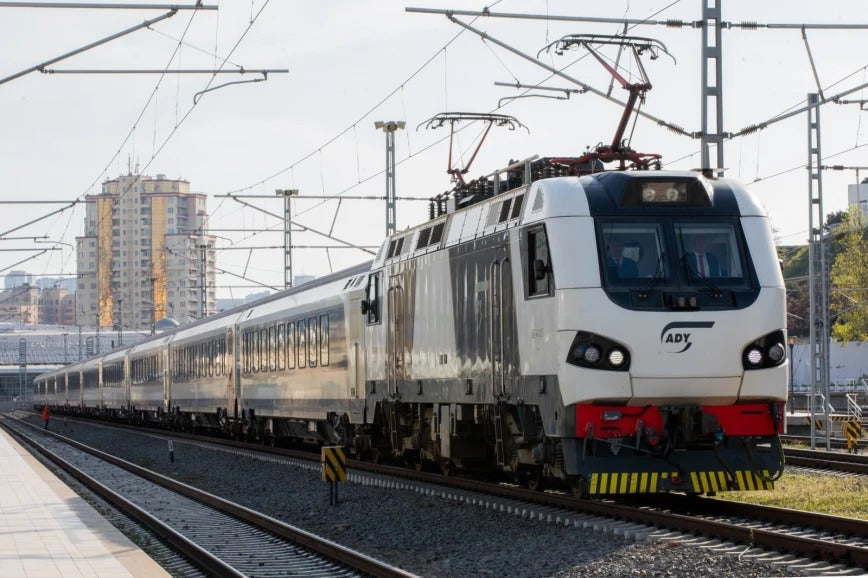
According to reports in regional media, the overnight train will use new Stadler rolling stock operated by Azerbaijan Railways. Initial schedules suggest departures from Baku shortly before midnight with arrival in Tbilisi the following morning, while southbound departures from Tbilisi will leave in the evening and arrive in Baku early the next day. Intermediate stops are expected to include Ganja, Agstafa and Gardabani.
Before its suspension, the sleeper train was widely regarded as one of the most affordable and convenient ways to travel between the two capitals. The reopening is expected to attract both tourists and international rail enthusiasts interested in overland travel across the Caucasus. It also restores an important missing link in the region’s growing international rail network centred on the Baku–Tbilisi–Kars corridor.
Image courtesy of Azerbaijan Railways.
European Sleeper Confirms Milano Launch After Bond Campaign Success
European overnight rail operator European Sleeper has confirmed that its long-awaited Brussels–Milano night train will launch on September 9 following the success of a major fundraising campaign.
The open-access operator announced that it had reached its initial €2 million bond target within 48 hours of opening sales, prompting the company to increase the campaign to €3.5 million. The additional funding will support network expansion, onboard improvements and potentially revive plans to acquire its own rolling stock.
The new service will operate three times a week between Brussels and Milano, running via Köln and Switzerland. From the December 2026 timetable change, the train will also serve Antwerpen, Breda and Eindhoven, creating a direct overnight connection between the Netherlands and Italy for the first time in decades.
European Sleeper had previously indicated that the service could include an Amsterdam portion, but the company has now confirmed that this will not go ahead. Instead, Dutch passengers will board at Breda and Eindhoven, while Belgian passengers will also be able to join at Antwerpen as well as Brussels.
When the service launches in September 2026, it is expected to call at Zürich before continuing over the historic Gotthard route through the Swiss Alps into northern Italy. However, European Sleeper says that from the December 2026 timetable change it intends to replace the Zürich stop with Aarau, which the operator describes as a more central location with convenient onward connections across Switzerland.
Bookings for the new route open on June 2, with tickets initially available until January 3, 2027. European Sleeper will also open bookings for its existing Brussels–Praha and Paris–Berlin services on June 9, with all routes available for Christmas travel.
The operator’s Paris–Berlin service will additionally begin serving Hamburg from July 14 as part of a revised routing through Germany.
European Sleeper says the strong response to its fundraising campaign demonstrates growing public demand for international overnight rail travel across Europe.
Far North Line to Close for Three Weeks for Major Infrastructure Upgrades
Passengers using Scotland’s Far North Line will face almost three weeks of disruption in June as Network Rail carries out a £6 million programme of engineering work aimed at improving reliability and resilience on one of the Highlands’ most important rail routes.
No trains will operate between Dingwall and Wick from late on June 7 until early on June 29, with ScotRail introducing replacement coaches and minibuses throughout the closure period.
The work will affect all services to and from Wick and Thurso, with replacement coaches operating between Inverness and Wick from June 8 to June 28. Minibuses will provide connections at Tain, Golspie and Helmsdale, while a limited train service will continue to run between Inverness and Dingwall, calling at intermediate stations.
Network Rail said the project includes the renewal of more than four kilometres of track, repairs to a railway bridge, drainage improvements and maintenance work at the level crossing at Rogart. Upgrades will take place at several locations, including near Alness, Tain and Lairg, as well as on sections further north towards Wick and Thurso.
ScotRail services between Inverness and Kyle of Lochalsh will continue to operate normally during the engineering programme.
Passengers are also being advised that several services immediately before and after the closure will be cancelled, including the 1754 Inverness to Wick service on June 7 and the 0618 and 0802 Wick to Inverness services on June 29.
National Rail has urged passengers to check their journeys before travelling and allow additional time when using replacement transport, which may be busier than usual.
The Far North Line is one of Britain’s most scenic and remote railways, linking Inverness with communities across the north of Scotland.