Summer engineering works disrupt key Transylvanian rail routes
Major engineering works on the Romanian rail network will lead to widespread service changes and partial closures on the line between Miercurea Ciuc and Brașov (Table 1610) this summer, affecting both domestic and international trains operated by CFR Călători.
From May 25 to September 15, several international InterRegio services linking Budapest and Brașov — including IR 367 and IR 407 — will be curtailed, terminating at Miercurea Ciuc. Replacement road transport will operate over the closed section to Brașov.
A similar pattern applies in the opposite direction between May 26 and September 16, with IR 366 and IR 406 starting from Miercurea Ciuc instead of Brașov. Passengers will again be transferred by road between the two cities.
Domestic long-distance services are also heavily affected. Overnight trains between Bucharest and Satu Mare will be replaced by diverted services (IR 12647/12648), with bus substitutions between Brașov and Siculeni. Meanwhile, services linking Brașov and Iași will be truncated, running only on the Bacău–Iași section.
Additional temporary services will operate around the disruption, including modified routes for trains between Bucharest and Târgu Mureș. These will require bus transfers between Tușnad Sat and Miercurea Ciuc.
Summer seasonal trains to the Black Sea are also being reworked. Services between Constanța and northern Romania will be diverted via alternative routes, bypassing Brașov entirely, with replacement branches serving key intermediate cities such as Cluj-Napoca.
Passengers travelling on affected services are entitled to refunds for unused tickets, either in full or for the untravelled portion of their journey, in line with national rail regulations. Travellers are advised to check journey details in advance, as further alterations to regional services will be announced locally.
The works form part of a broader programme to modernise infrastructure on one of Romania’s key cross-Carpathian corridors, though passengers should expect longer journey times and multiple transfers throughout the summer period.
Italo to target Frankfurt–Köln and München–Berlin in €3.6bn German market entry
Italian open-access operator Italo is preparing a major expansion into Germany, signalling a direct challenge to incumbent Deutsche Bahn. Backed by an investment of around €3.6 billion, the move represents one of the most ambitious attempts yet to break into Germany’s long-distance rail market.
Reports suggest Italo will deploy a fleet of 26 high-speed trains built by Siemens Mobility, likely based on the Velaro platform already used extensively by Deutsche Bahn. This should simplify certification and allow for smoother entry into the German network.
Across the reporting, two high-speed routes come up repeatedly as likely launch corridors: Frankfurt–Köln and München–Berlin. Both are among Germany’s busiest long-distance markets, combining strong business and leisure demand with fully high-speed infrastructure. Targeting these corridors would place Italo in immediate, head-on competition with Deutsche Bahn’s ICE services.
The strategy reflects Italo’s approach in Italy, where it successfully challenged the state operator by focusing on dense, high-yield routes with frequent, high-quality services. Replicating that model in Germany could prove attractive, particularly as European rail markets continue to liberalise.
However, significant hurdles remain. Limited network capacity, especially on core corridors, and the complexities of securing train paths may constrain initial operations. Brand recognition and competitive pricing will also be critical.
If Italo succeeds, its entry could mark a turning point for Germany’s rail market, intensifying competition on key high-speed routes and further reshaping Europe’s evolving passenger rail landscape.
Tauern Tunnel to close for major upgrade in 2027
ÖBB-Infrastruktur AG has confirmed that the second phase of works on the Tauern Tunnel will take place between February 8 and July 9, 2027, requiring a full closure of one of Austria’s key north–south rail corridors.
The tunnel, which lies on the Tauernbahn linking Salzburg with Klagenfurt am Wörthersee, will undergo extensive modernisation. Works will focus on renewing the tunnel lining and railway systems in its southern section near Mallnitz, alongside a broader package of upgrades across the route.
To mitigate disruption, a comprehensive replacement timetable is planned. Hourly direct buses will operate between Bischofshofen and Spittal an der Drau, while a separate rail replacement service will link Schwarzach-St. Veit with Bad Gastein. Long-distance trains will continue to serve the southern section between Mallnitz-Obervellach and Spittal-Millstättersee every two hours, with night trains diverted.
ÖBB is also bundling additional works into the closure, including viaduct renewals, tunnel upgrades, track replacements, and the modernisation of Rothenthurn station. The Tauern car shuttle will be upgraded with digital ticketing and improved accessibility, with services resuming on July 10, 2027.
The timing has been coordinated with engineering works by Deutsche Bahn on the corridor via Rosenheim and Freilassing, aiming to reduce the overall impact on international freight traffic.
Poland to expand Adriatic Express for Summer 2026
Polish long-distance operator PKP Intercity is set to expand its seasonal Adriatic Express service to the Croatian coast for Summer 2026, following strong demand in its inaugural year.
The direct train linking Warszawa with Rijeka will return on June 26, running through to September. Frequency is expected to increase significantly, from four departures per week in 2025 to as many as six this year.
Journey times will also be trimmed by around one hour, bringing the end-to-end trip down to approximately 18 hours. Capacity is being boosted too, with train formations increasing from three to four coaches.
A notable development for 2026 is the addition of a Slovenian portion. Selected coaches will be detached at Ljubljana and continue to Koper, giving the service a broader Adriatic reach. Passengers will also be able to purchase through tickets combining rail and coach travel onwards to Trieste.
Operationally, the service will again be based on the existing Sobieski trains between Warszawa and Wien, where additional through coaches will be attached for the southbound journey. As in 2025, portions are expected to be combined with other international services further south.
Last year’s service also attracted passengers from the Czech Republic, with intermediate stops including Bohumín and Ostrava. Details of international ticket sales for 2026 have yet to be confirmed.
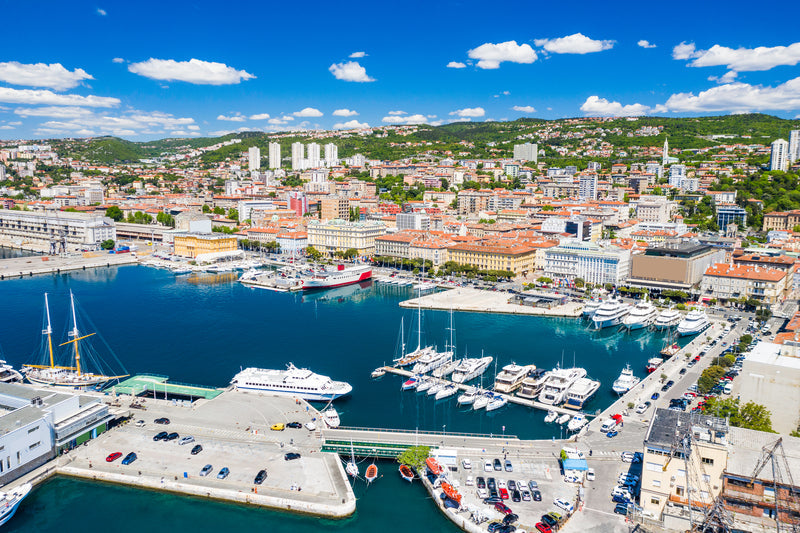
Our cover photo this week is an aerial panoramic view of Rijeka city centre, marina and harbour. ID 184703912. © Ilijaaa. Dreamstime.com