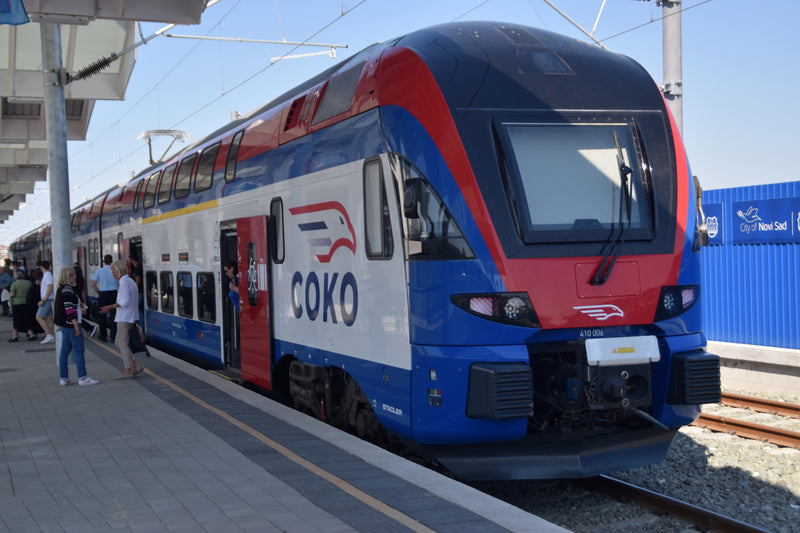
Our cover photo this week depicts a Serbian Soko train at Novi Sad. The "Coko" branding is written in Serbian Cyrillic which is written in Latin form as "Soko" - it means Falcon. Photo ID 248896011 by Ivan Pancic from Dreamstime.com.
Germany
Italian train operators are gearing up to challenge Deutsche Bahn’s long‑distance dominance. According to the Frankfurter Allgemeine Zeitung, the private operator Italo (backed by shipping giant MSC) is planning a billion‑euro push into Germany’s high‑speed rail market. The company has reportedly set up a German subsidiary, applied for an operating licence, and is seeking long-term (15‑year) track access agreements. Italo is said to be planning hourly or two-hourly services on routes that would directly target DB’s core intercity business.
Italian national operator Trenitalia is already preparing Frecciarossa trains for high-speed services between Italy and Germany. Starting in December 2026, Trenitalia will launch Frecciarossa 1000 services between München and Milano, and München and Roma, in cooperation with Deutsche Bahn and Austrian operator ÖBB. By December 2028, these routes are expected to expand to include Berlin and Napoli. The trains being used, Frecciarossa 1000 (ETR1000), are being adapted and certified for use on German and Austrian networks.
Italo’s ambition, meanwhile, reflects growing pressure for more competition in Germany’s high-speed rail market, where Deutsche Bahn has long held over 90% share. If successful, these moves could mark a major shift in the German rail landscape — offering passengers more choice and potentially lowering prices on some long-distance routes.
Estonia/Latvia
Reports in the Estonian media suggest that Elron’s long-planned express train between Tartu and Riga is now on course to begin operating in mid-December. The journey is expected to take around three and a half hours, although ticket prices have yet to be revealed.
The service was originally scheduled to launch last year, during Tartu’s stint as European Capital of Culture, but delays pushed the project back. Elron now believes a December 15 start is achievable. On the Latvian side, the train will call at four intermediate stations before reaching Riga, while in Estonia it will follow the established timetable to Valga. Work is under way to adjust domestic schedules so that trains can cross the border without lengthy pauses.
European regulators have so far authorised one two-car train and crew for use on the route, but a total of three sets will be needed for full operation. The approval process for the remaining two is still continuing, and Elron hopes they will be cleared by late November or early December.
Provisional timings indicate that the southbound service would leave Tallinn in mid-afternoon, arrive in Tartu around 18:30 and reach Riga shortly after 21:00. Northbound departures from Riga are planned for early morning, connecting into the Estonian network for the onward journey to Tallinn. Final timings will depend on infrastructure works currently taking place on both sides of the border.
The route also aligns with the new coalition agreement between Isamaa and the Reform Party, which commits Tartu to fostering faster rail links with Tallinn and Riga. Joint marketing with Riga and other municipalities along the line is planned, while Elron confirms that the Tallinn–Vilnius connection will continue alongside the new express.
Sweden/Denmark/Germany
Snälltåget has announced a major expansion of its international services, confirming the launch of a new direct day train linking Hamburg, København, Malmö and Stockholm from May 4, 2026. Trains will depart Hamburg and Stockholm each morning, offering a comfortable same-day journey between northern Germany and the Swedish capital.
The move comes amid steadily growing demand for cross-border rail travel. “We are seeing a significant increase in interest in train travel between Germany, Denmark and Sweden and have therefore decided to introduce day train connections that run directly from Hamburg to Stockholm,” says Marco Andersson, Snälltåget’s Commercial Manager. “The new connection complements our night train service and makes international train travel even more attractive – without changing trains in København or Malmö.”
The northbound and southbound trains will follow an identical route, calling at Neumünster, Padborg, Kolding, Odense, København Syd, Malmö, Lund, Eslöv, Hässleholm, Alvesta, Nässjö, Linköping, Norrköping and Södertälje. The end-to-end journey time is around 11 hours, with Snälltåget’s well-known restaurant car Krogen available throughout the trip.
Alongside the new daytime service, Snälltåget will also increase the number of departures on its Berlin – Hamburg – København – Stockholm overnight route during the 2026/27 low season. With the current contract for night train operations ending in summer 2026, the company plans to step up its own offering, with detailed timetables to be published in spring 2026.
Tickets for both the new Hamburg–Stockholm direct train and the existing night trains operating between May 4 and November 1 are already on sale.
Serbia/Hungary/Austria
A draft of the 2025/26 railway timetable briefly published on the website of the Railway Infrastructure of Serbia (IŽS) has offered the clearest indication yet of future services between Beograd and Budapest. Although the document covered only the Serbian section of the route, it suggested that six trains per day will operate in each direction: three run by Srbija Voz using new high-speed units from Chinese manufacturer CRRC, and three by MÁV.
Railway enthusiasts were swift to spot that two MÁV services towards Beograd – and two heading back to Budapest – carry the same train numbers currently used on the Budapest–Wien corridor. When approached by the media, Austrian Federal Railways (ÖBB) confirmed the plans stating that it was working with MÁV to introduce trains between Beograd, Budapest and Wien in the future. It is possible trains may start as early as Spring 2026.
Buy the latest digital edition of the European Rail Timetable.