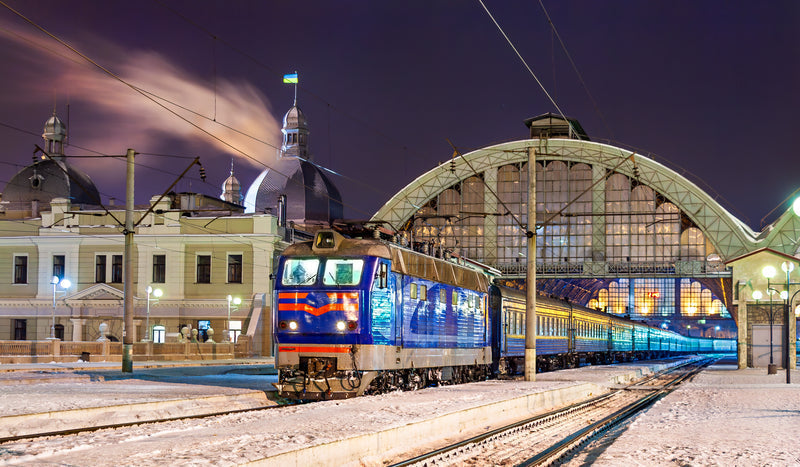
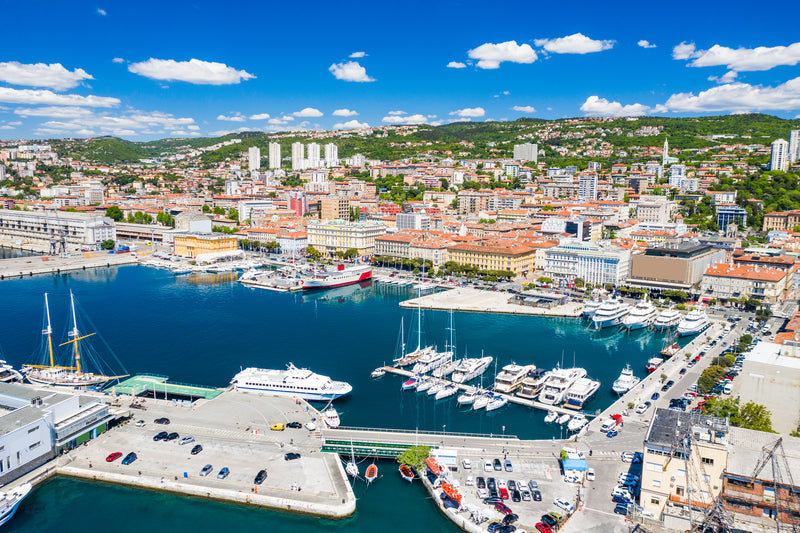
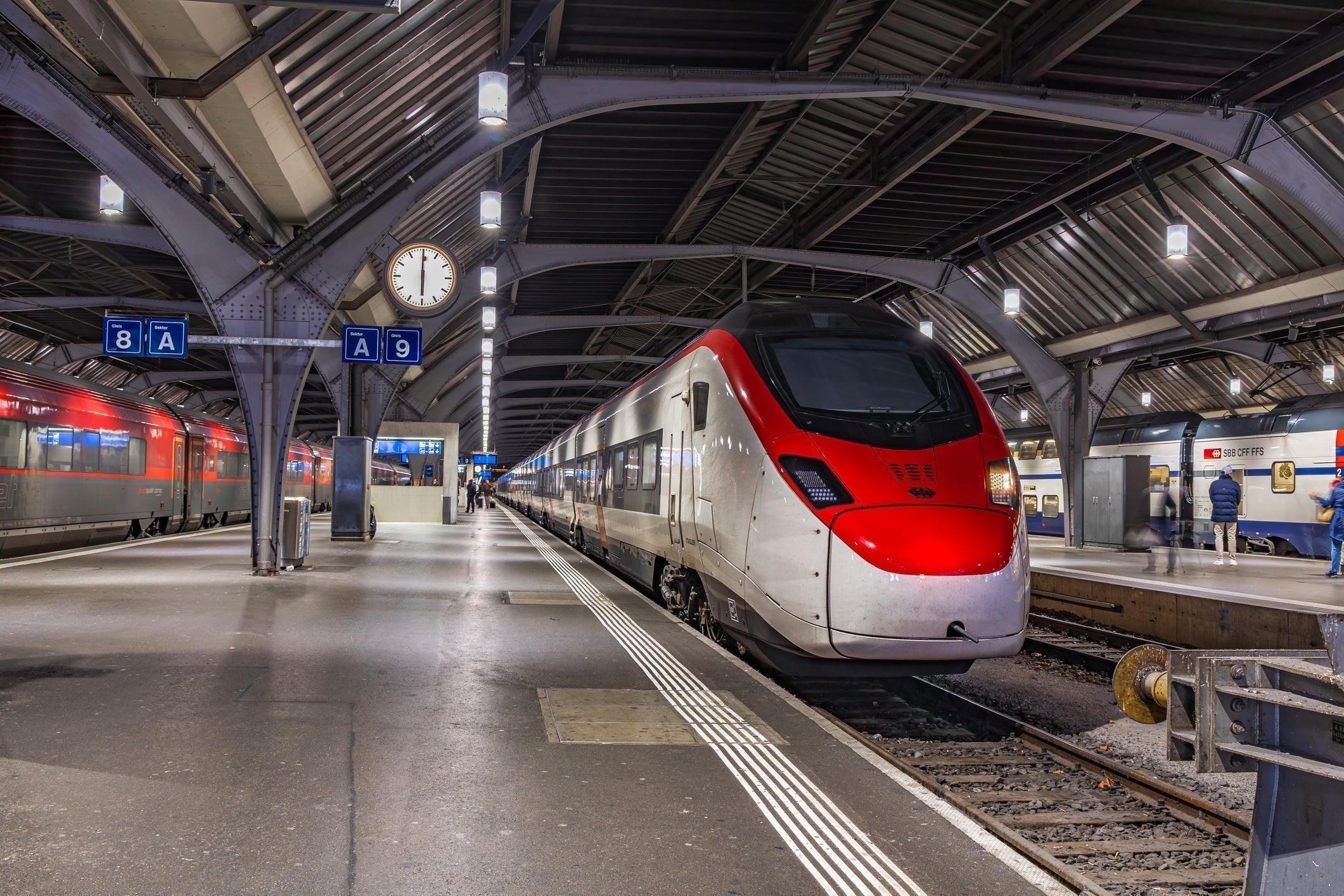
Our cover photo this week shows an Enterprise service at Drogheda. Photo ID 273091178 © Anze Furlan | Dreamstime.com.
22/12/2025
New Trains Signal a New Era for Ireland’s Railways
Ireland’s railways are on the cusp of a significant modernisation, with major new train orders announced for both the flagship Dublin–Belfast Enterprise service and Dublin’s suburban DART network.
On the cross-border route, Iarnród Éireann and Northern Ireland Railways have selected Stadler to supply eight new electro-diesel Flirt trainsets to replace the ageing locomotive-hauled Enterprise trains. Based on Stadler’s proven Flirt platform, the new units will be capable of running under the Dublin area 1.5 kV DC electrification and in diesel mode elsewhere, with onboard batteries allowing short zero-emission operation in sensitive areas such as Belfast’s Grand Central station. The design is also future proofed to allow diesel equipment to be replaced with full electric capability if electrification is expanded.
For passengers, the new Enterprise trains promise a step change in comfort and accessibility. Level boarding, low-floor interiors, generous PRM spaces, seven toilets per train and improved catering — including hot meals at seat in first class — will bring the service firmly into the modern era. Entry into service is planned for 2030, finally allowing the withdrawal of the long-serving Class 201 locomotives and De Dietrich coaches.
In Dublin, the Government has funded a further 100 new electric DART carriages, to complete the replacement of the original fleet introduced in 1984. This latest €173.9 million order brings total DART investment to around €670 million and 285 new carriages. Alongside earlier orders entering service from 2027 and 2028, the new trains will deliver more capacity, better accessibility, enhanced security and improved facilities across the expanding DART+ network.
Together, these investments underline a renewed confidence in rail — north and south — at a time of record passenger demand.
17/12/2025
Leo Express to launch Frankfurt–Praha–Poland–Ukraine border rail service in June 2026
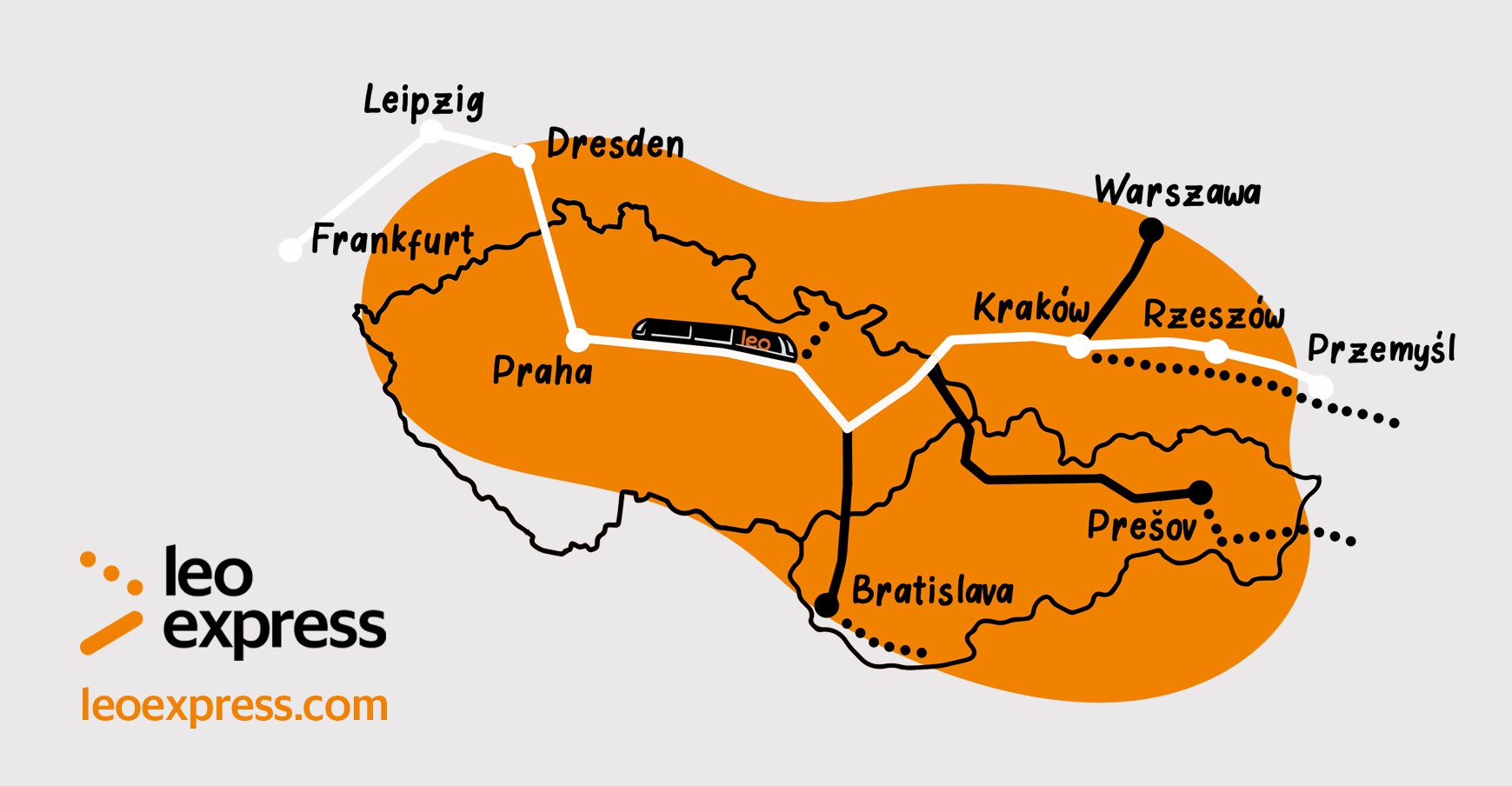
Leo Express has announced plans to launch a new trans-European rail service linking Germany and the Czech Republic with eastern Poland close to the Ukrainian border. The new route will operate once daily in each direction from June 25, with tickets already on sale from €10.
The service will run between Frankfurt Airport and Przemyśl, calling at major cities including Frankfurt, Erfurt, Leipzig, Dresden, Praha, Ostrava and Kraków. With a total length of more than 1,300 kilometres, it will rank among the longest direct train services currently planned in Europe.
Train 232 will depart Przemyśl at 13:31, arriving at Frankfurt Airport the following morning at 07:53. The return working, Train 235, will leave Frankfurt Airport at 08:27, reaching Przemyśl at 02:23 the next day.
Leo Express CEO Peter Köhler said the new route would connect key administrative, financial and industrial centres such as Frankfurt with major cultural cities including Praha and Kraków, while also strengthening rail links towards Ukraine. He added that the service would provide an alternative to existing long-distance operators in Germany.
Trains will offer Wi-Fi, power sockets, air conditioning and onboard refreshments. Tickets are currently sold without seat reservations, though reserved seating and a Business Class option will be introduced from January. Passengers who book earlier will be able to select seats once reservations are activated.
Some operational variations will apply due to engineering work. On Mondays, departures towards Przemyśl leave Frankfurt Airport four hours later, while on Tuesdays and Wednesdays the service operates only between Frankfurt Airport and Bohumín, and on Wednesdays and Thursdays only between Bohumín and Frankfurt Airport. Timetables are indicative and subject to change. Domestic travel within Poland is not currently available.
16/12/2025
Table 78: European Sleeper Paris–Brussels–Berlin
European Sleeper will introduce a new overnight passenger service linking Paris, Brussels and Berlin from March 26, marking a significant expansion of its international night train network. The new train will operate on three nights per week, complementing the company’s existing Brussels–Berlin service, which runs on alternate days. Together, the two services will create a six-nights-per-week overnight connection between Brussels and Berlin, substantially improving frequency and flexibility for travellers.
On departure days, the new service will leave Paris on Tuesdays, Thursdays and Sundays at 17:45, offering an early-evening departure suitable for both leisure and business passengers. The train will call at Brussels at 21:45, providing convenient interchange opportunities with other Belgian and international services, before continuing overnight through Germany. Arrival in Berlin is scheduled for 09:59 the following morning, allowing passengers to reach the German capital at the start of the day.
In the southbound direction, the return working will depart Berlin on Mondays, Wednesdays and Fridays at 18:31. After an overnight journey, the train is due to arrive in Brussels at 07:06, with onward arrival in Paris at 10:00. These timings are designed to allow overnight travel between all three cities while making efficient use of rolling stock.
The introduction of the Paris–Brussels–Berlin service strengthens European Sleeper’s position in the growing market for international overnight rail travel and provides a direct night-time link between France and Germany.
15/12/2025
RegioJet Scales Back Initial Polish Timetable Ahead of December Change
Czech private operator RegioJet adjusted its expansion plans in Poland shortly before the introduction of the new December timetable, scaling back the number of services it had originally planned to launch. The changes were announced on Thursday, December 11, just three days before the new timetable came into force.
From Sunday, December 14, RegioJet reduced its planned Warsaw–Kraków offer from six to three daily pairs of trains. On the Gdynia–Kraków route, only one of the originally planned three pairs will now operate. In total, 1,080 services were withdrawn from the timetable, significantly reducing the number of seats RegioJet had intended to offer during the busy pre-Christmas period. State-owned operator PKP Intercity criticised the timing and scale of the decision, arguing that it created uncertainty for passengers who had already purchased tickets.
RegioJet has explained the reductions as a pragmatic operational decision. Owner Radim Jančura said the company is still in a trial phase on the Polish market and is facing a shortage of qualified staff, particularly train drivers. Rather than risk reliability issues, the operator opted to introduce services more gradually. Passengers affected by cancellations are being refunded, and RegioJet is also offering a PLN 100 credit as an apology.
The carrier plans to begin adding further services between Kraków, Warsaw and the Tri-City from mid-January, once staffing levels improve. RegioJet launched Polish operations in September and says more than 33,000 passengers have already travelled on its Warsaw–Kraków services. From the new timetable, it will also introduce a new international connection between Warsaw and Prague, expanding its presence in Central Europe.
11/12/2025
Seasonal Warsaw–Rijeka Train Set to Return for Summer 2026
Although an official announcement is still pending, Italian newspaper Il Piccolo reports that the seasonal Warszawa–Rijeka service is expected to return in summer 2026. Croatian State Railways has indicated that negotiations with PKP Intercity are close to completion, supported by the positive operational experience gained during the line’s first season. The train will run from June 27 to August 30, similar to the 2025 schedule.
Operationally, the service represents a substantial undertaking. The train links the Polish capital with the Kvarner region via a long cross-border route, requiring close coordination between infrastructure managers in both countries as well as with Slovenia, through which the service also passes. Last year’s operation demonstrated that the pathing could be reliably maintained despite the considerable distance and the varied network conditions encountered along the way.
With planning for 2026 now approaching its conclusion, the intention is to build on these operational strengths. The train is expected to keep a similar timetable and formation, providing a dependable overnight link between Central Europe and the Croatian coast at the height of the summer season.
10/12/2025
European Sleeper to Launch Night Train from Amsterdam and Brussels to Milano
European Sleeper is expanding its night train network with a new service linking Amsterdam and Brussels to Milano, starting June 18, 2026. The train will run three times per week, offering direct journeys from both Amsterdam and Brussels, and allowing passengers to arrive in Switzerland and Milano the following morning.
The route passes through Köln, Bern, Brig, Domodossola, and Stresa before reaching Milano, following the historic Simplon route through the Alps. Early-morning and evening travellers will enjoy striking views of Alpine valleys and serene lakes along the way. Separate portions from Amsterdam and Brussels are combined in Western Germany to provide convenient departure and arrival times for both cities.
Departures from Amsterdam and Brussels are scheduled for Monday, Thursday, and Saturday evenings, with return trips from Milano on Wednesday, Friday, and Sunday nights. Ticket sales for the service are expected to open in January or February 2026, with prices similar to existing European Sleeper offerings, starting around €80 for a sleeping car berth.
European Sleeper has steadily expanded its network since launching in 2023, including routes connecting Brussels, Amsterdam, Berlin, Dresden, and Praha, and will also begin a Paris–Berlin night train on March 26, 2026. The new Milano service marks a major addition to the operator’s portfolio, providing a comfortable and sustainable overnight travel option through Switzerland and northern Italy.
Swiss House Blocks Funding for Planned Night Train to Sweden
The Swiss government will not be able to subsidise the planned overnight train from Basel to Malmö, due to launch in spring 2026, after the House of Representatives removed the CHF 10 million budget allocation. The Senate had already struck out the funding, leaving Swiss Federal Railways (SBB) without the federal support it says is essential for operating the service three times a week.
SBB plans to start the Basel–Malmö night train in April 2026, offering connections via cities such as Hamburg. However, although night trains remain popular, SBB argues they are not commercially viable without subsidies, citing high operating and staffing costs.
A majority in the House rejected the funding on Tuesday by 99 votes. Alex Farinelli of the Radical-Liberal Party noted that while the CO₂ Act allows subsidies for international night trains, it does not require them. He said the proposed support would equate to CHF 100–200 per ticket. Asked by Franziska Ryser of the Greens what he would tell families who had already booked travel, he responded that they should seek refunds from SBB.
Yvan Pahud of the Swiss People’s Party criticised the subsidy as wasteful and claimed the route would mainly serve tourists. Finance Minister Karin Keller-Sutter reminded the chamber that the funding had originally been placed in the budget at Parliament’s own request.
Ursula Zybach of the Social Democrats countered that the service would benefit more than just holidaymakers and argued that well-connected night trains offer a credible, climate-friendly alternative to aviation, a point echoed by Simon Stadler of the Centre Party.
Sweden Sets New Structure for Stockholm–Upper Norrland Night Train Services
Sweden’s Transport Administration has outlined a new structure for night train operations between Stockholm and Upper Norrland, securing services until at least 2030, when a new fleet of overnight trains is expected to enter service.
Under the revised arrangement, two overnight services will run daily: one on the long-distance Stockholm–Narvik route, and the other between Stockholm and Umeå. The new schedule takes effect on April 13, 2026 under the existing contract with SJ, and the next procurement round, starting in December 2026, will follow the same principles. Previously, both services operated only on the Stockholm–Narvik route.
“We are now adapting the requirements to ensure continued traffic within the given financial framework and to meet existing needs and demand,” said Lennart Kalander, Head of Department at the Swedish Transport Administration. He added that operators can expand services during high-demand periods and that the new structure will free up capacity on the busy Ore Line.
The upcoming night train fleet, expected from 2030, promises higher comfort than today’s rolling stock and is expected to reduce maintenance costs. Alongside the service changes, the Transport Administration has been tasked with assessing demand for night train travel and evaluating options for ownership, management, and financing of the state-owned vehicle fleet. The findings must be submitted no later than December 31, 2026.
“We are keen to find solutions that ensure good accessibility throughout the country in the future,” Kalander said.
09/12/2025
GoVolta Launches Affordable International Trains from the Netherlands
GoVolta, a new Dutch train company, will start running international trains from Amsterdam in 2026. The company will offer direct connections to Berlin and Hamburg, with a daily service to Paris planned from December 2026.
The first Amsterdam–Berlin train departs on March 19, followed by the Amsterdam–Hamburg service on March 20. Initially, both routes will run three times a week, increasing to daily departures in the summer. Stops along the Berlin route include Amersfoort, Deventer, Hengelo, Bad Bentheim, Osnabrück, and Hannover, while the Hamburg train will call at Amersfoort, Deventer, Hengelo, Bad Bentheim, and Bremen.
Tickets start at €10 one-way, with the average fare to Berlin around €30. GoVolta offers two comfort classes: Economy and Comfort, both guaranteeing a reserved seat. Travelers can also upgrade to an XL Duo Seat for extra personal space. Onboard facilities include a lounge car, clear baggage rules, and a seat reservation system.
Co-founders Maarten Bastian and Hessel Winkelman say the aim is to make international train travel simple, affordable, and reliable.
GoVolta works with Keolis for train operations and Brouwer Technology for equipment maintenance, combining operational expertise with a clear customer experience. Beyond Germany and France, the company plans further expansion across Europe, offering a practical alternative to short-haul flights.
Tickets and combined city trips can be booked via www.govolta.nl.
08/12/2025
Wien – Milano - Genova - La Spezia Nightjet Withdrawn for 2026
The Nightjet services linking Wien and München with Milano, Genova and La Spezia are to be withdrawn for the whole of the 2026 timetable year, with confirmation emerging only quietly despite the scale of the cut. The news first surfaced on an Italian railway enthusiast forum, where users noticed that the newly published ÖBB timetable synoptics no longer included the La Spezia services. The observation was soon matched by information on the ÖBB and Nightjet websites.
According to ÖBB, both the München – La Spezia Nightjet (NJ 40295/40230) and the Wien – La Spezia Nightjet (NJ 233/230) will be suspended throughout 2026. The operator cites the high number of major construction sites planned along the route as the reason for withdrawing the trains. With extensive engineering work scheduled across several key sections of the Italian and cross-border network, ÖBB concluded that maintaining reliable overnight paths would not be possible.
A notice on the Nightjet website confirms that connections to and from La Spezia cannot be offered in the 2026 timetable year, while emphasising that other Nightjet routes to Italy are not affected. Services to Roma and Venezia will continue to run normally and are already open for booking.
The Wien and München – La Spezia Nightjets have provided a valued direct overnight link to the Ligurian coast, particularly for travellers heading to La Spezia and the Cinque Terre. Their year-long withdrawal leaves a significant gap in the network, and ÖBB has yet to indicate whether the services will return for the 2027 timetable.
04/12/2025
Kazakhstan
Kazakhstan is set to see a significant upgrade in passenger rail services from mid-December 2025. Kazakhstan Temir Zholy is launching new and expanded routes to improve connectivity, reduce travel times, and provide more comfortable travel options during the winter months.
From December 16, the new Talgo route No. 119/120 Almaty – Kostanay will operate on even-numbered days. This service will cut travel time by 12 hours compared with standard trains and will link key cities including Tobol, Atbasar, Astana, Karaganda, and Almaty. Talgo’s modern carriages offer enhanced comfort, with specially designated seats for passengers with disabilities available at up to a 50% discount.
Additionally, starting December 14, Atyrau – Almaty trains 41/42 will switch to a daily schedule, strengthening links between the western and southern regions of Kazakhstan. The train will consist of over 15 renovated compartment and reserved-seat carriages and can accommodate approximately 700 passengers.
Kazakhstan Temir Zholy is also extending Talgo train 65/66 from Astana to Zhezkazgan onwards to Kyzylorda, operating every other day. The extension will reduce travel time by seven hours and serve over 400 passengers per journey.
Finally, daily Talgo service between Almaty and Tashkent will begin on December 14, carrying over 400 passengers per day. This service aims to enhance transport connections with Uzbekistan, support tourism, and strengthen cultural and business ties.
03/12/2025
France
SNCF Voyageurs has announced plans to introduce a new direct Ouigo TGV service between Lyon and Bordeaux by summer 2027, aimed at strengthening cross-country high-speed links and addressing a long-standing gap in France’s Interconnexion network. Revealed on November 27, the new service will run daily in each direction, offering a fast and affordable option on what is currently one of the country’s busiest domestic air corridors.
The train will depart Lyon Part-Dieu at 08.00, calling at Massy TGV, Saint-Pierre-des-Corps, Poitiers and Angoulême before arriving in Bordeaux Saint-Jean at 13.02. The return working will leave Bordeaux at 13.58, reaching Lyon at 19.00. The timetable is designed to provide convenient connections at intermediate hubs while still maintaining competitive end-to-end journey times.
At present, the quickest rail journey between the two cities is 4 hours 21 minutes, requiring a change from the 10.30 Inoui departure from Lyon at Massy to connect into Ouigo 7673. The introduction of the through service removes this interchange and is expected to make rail travel more attractive for leisure and business passengers alike.
By offering a direct, low-cost alternative, SNCF Voyageurs hopes to capture a larger share of the market from air travel while supporting broader efforts to promote environmentally sustainable long-distance transport.
02/12/2025
Great Britain
Several significant timetable changes will take effect across Great Britain in the upcoming timetable period, bringing improved frequencies, clearer patterns and extended connectivity on several key routes.
In the Northeast, Northern is undertaking a substantial re-cast of services covered in Tables 209–212. The Middlesbrough – Newcastle corridor sees the most notable enhancement: every other train will now continue beyond Hexham to Carlisle, creating a simple hourly pattern linking Middlesbrough, Newcastle and Carlisle, supplemented by an hourly Middlesbrough – Newcastle service and an hourly Newcastle – Carlisle service. These improvements apply Monday to Saturday. In addition, services between Saltburn and Bishop Auckland are being re-timed to provide a consistent, regular pattern throughout the day.
The most high-profile development is the overhaul of East Coast Main Line services between London, York, Newcastle and Edinburgh. A broadly clock-face structure will operate every two hours, with only minor variations. Sunday services largely mirror the weekday pattern, although timings differ slightly. To reflect this reorganisation, schedules are now presented in two separate tables: one covering London – York, Leeds and Lincoln, and the other London – York – Newcastle – Edinburgh.
East Midlands routes also see meaningful changes. Services between Matlock, Derby, Nottingham and Lincoln are being combined to form a coherent hourly Matlock – Lincoln service seven days a week, with alternate trains extended to Cleethorpes on Mondays to Saturdays and two such extensions on Sundays. Adjustments have also been made on the Lincoln – Newark Northgate corridor, while the Crewe – Newark Castle service is extended to Lincoln on Mondays to Saturdays, giving the city a regular half-hourly service to Nottingham and Derby.
01/12/2025
Spain