Germany’s long-distance passenger rail market is entering a new phase of liberalisation, and the prospect of a new entrant from Italy has sharpened the debate. Italy’s private high-speed operator, NTV Italo, is exploring the possibility of launching services in Germany, reportedly considering an order for new trains if it can secure sufficient train paths on the German network.
The significance of this move lies in Italo’s track record. Since entering the Italian market in 2012, it has fundamentally reshaped intercity travel between cities such as Milano, Roma and Napoli. Competition with the state operator, Trenitalia, drove down fares, improved service quality and increased overall passenger volumes. Rail captured a greater share of demand from both aviation and private cars, while passengers benefited from higher frequencies and more differentiated service offerings.
Germany, however, presents a very different operating environment — and potentially a much larger opportunity.
Unlike Italy’s relatively linear north–south high-speed spine, Germany has a decentralised and multi-nodal geography. Berlin, Hamburg, München, Frankfurt, Köln, Düsseldorf and Stuttgart all generate substantial intercity demand, while secondary cities such as Leipzig, Hannover and Nürnberg add further density. Rather than a single dominant corridor, Germany offers a complex mesh of high-volume city pairs.
On paper, this structure is highly attractive for an open-access operator. Routes such as Berlin–München, Hamburg–Frankfurt, Köln–München and Berlin–Köln could each sustain competitive intercity services. Germany’s central position in Europe also opens logical extensions into Austria, Switzerland and the Netherlands, expanding the addressable market further.
The constraint, however, is not demand. It is infrastructure.
Germany’s rail network is under sustained operational stress. Decades of underinvestment, combined with rising passenger and freight volumes, have left core corridors congested and system reliability under pressure. Major hubs including Frankfurt, Köln, Hamburg and München already operate close to capacity for large parts of the day. Because services are tightly interdependent, disruption in one part of the network can cascade rapidly across the system.
This creates a structural challenge for new entrants. Open-access operators depend on stable, high-quality train paths that enable predictable, clockface timetables and competitive journey times. In Germany, spare capacity on the most commercially attractive corridors is limited, and even where paths exist, they are not always robust enough to support a premium long-distance product.
The problem is compounded by network design. Unlike France or Spain — and even parts of Italy — Germany has relatively few fully segregated high-speed lines. Long-distance ICE services frequently share infrastructure with regional passenger trains and freight traffic. This increases flexibility, but it also amplifies vulnerability: a signalling issue near Frankfurt or a delayed freight service outside Mannheim can propagate delays across hundreds of kilometres.
A further layer of uncertainty comes from large-scale infrastructure renewal. Germany is now undertaking extensive corridor reconstruction and modernisation after years of deferred maintenance. While necessary, these works will constrain capacity, introduce diversions and extend journey times across multiple corridors. For any operator considering hundreds of millions of euros in rolling stock investment, this volatility significantly increases commercial risk.
There is also the competitive reality of operating alongside Deutsche Bahn. While Germany formally supports market liberalisation, DB has limited incentive to facilitate the emergence of a strong rival on its most profitable long-distance routes. Access to train paths, station capacity, operational priorities and timetable coordination can all become friction points. In practice, incumbents in congested systems retain meaningful structural advantages, particularly where capacity allocation is the decisive constraint.
The experience of FlixTrain also demonstrates how difficult it is to challenge DB in practice. Despite Germany’s formal liberalisation, FlixTrain has remained a niche operator rather than a transformative competitor, constrained by limited network access, operational complexity and the overwhelming scale of DB’s incumbent position.
This context explains why train path allocation is central to Italo’s strategy. A fleet order is only commercially rational if there is confidence that trains can operate reliably, frequently and profitably over a long horizon. In Germany, achieving that level of certainty is significantly more difficult than in Italy, where dedicated high-speed infrastructure provides far greater operational stability.
Ultimately, the issue extends beyond formal liberalisation. Germany may permit open-access competition in principle, but meaningful competition depends on both physical capacity and the practical ability to use it on equal terms. Without improvements in reliability, capacity and operational neutrality, new entrants risk being confined to marginal paths that limit their competitive impact.
Nonetheless, the case for competition remains strong. Experience in Italy and Spain shows that new entrants can drive down fares, improve service quality and stimulate demand, particularly when rail is competing directly with short-haul aviation. This aligns with Germany’s broader climate and transport objectives, especially the need to decarbonise domestic mobility.
If Italo ultimately proceeds, it will test not only the commercial potential of the German market, but also the extent to which Europe’s largest rail system can accommodate genuine and effective competition. The opportunity is substantial — but so too are the structural, infrastructural and incumbent-related barriers that define it.
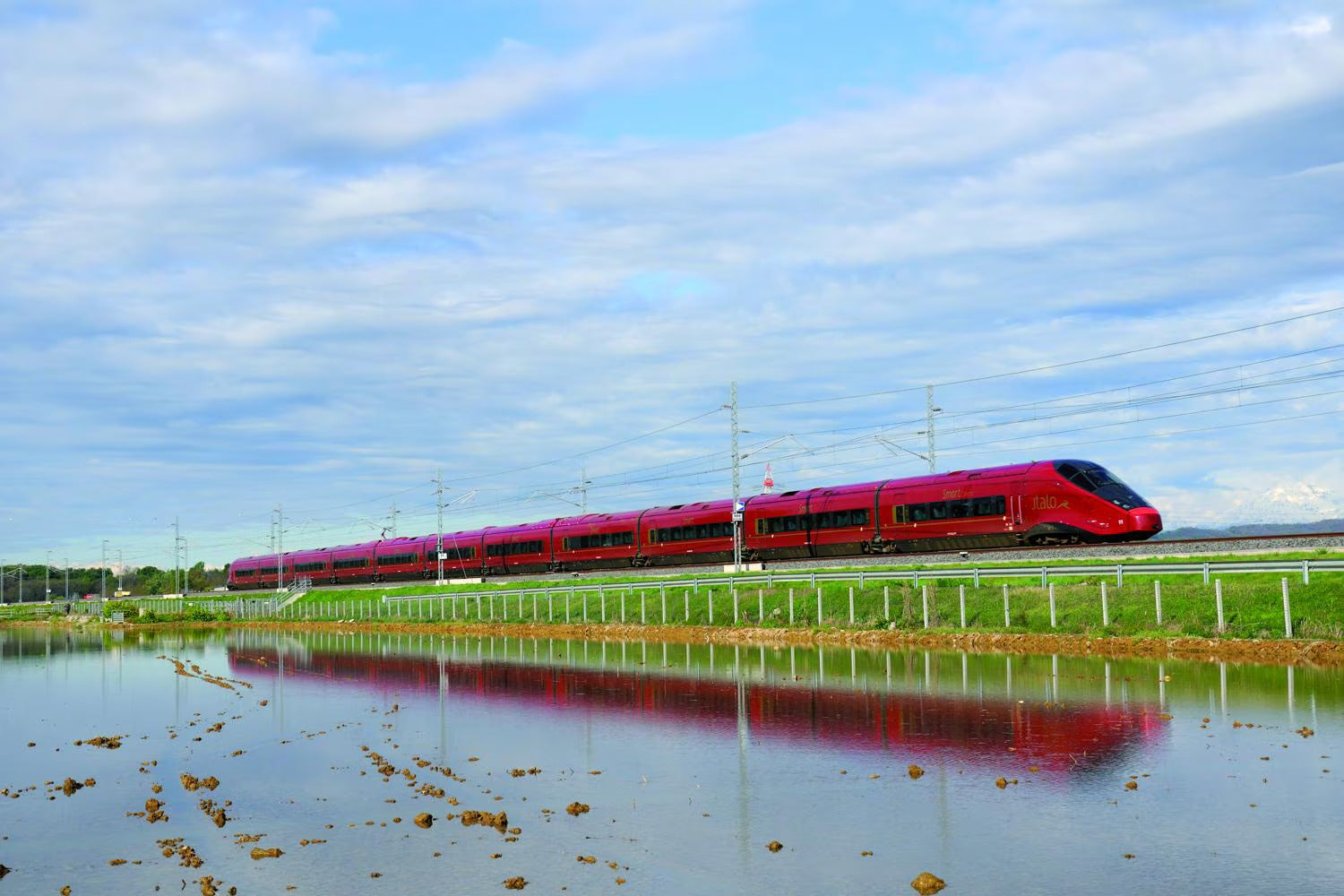
Image courtesy of Italo.