
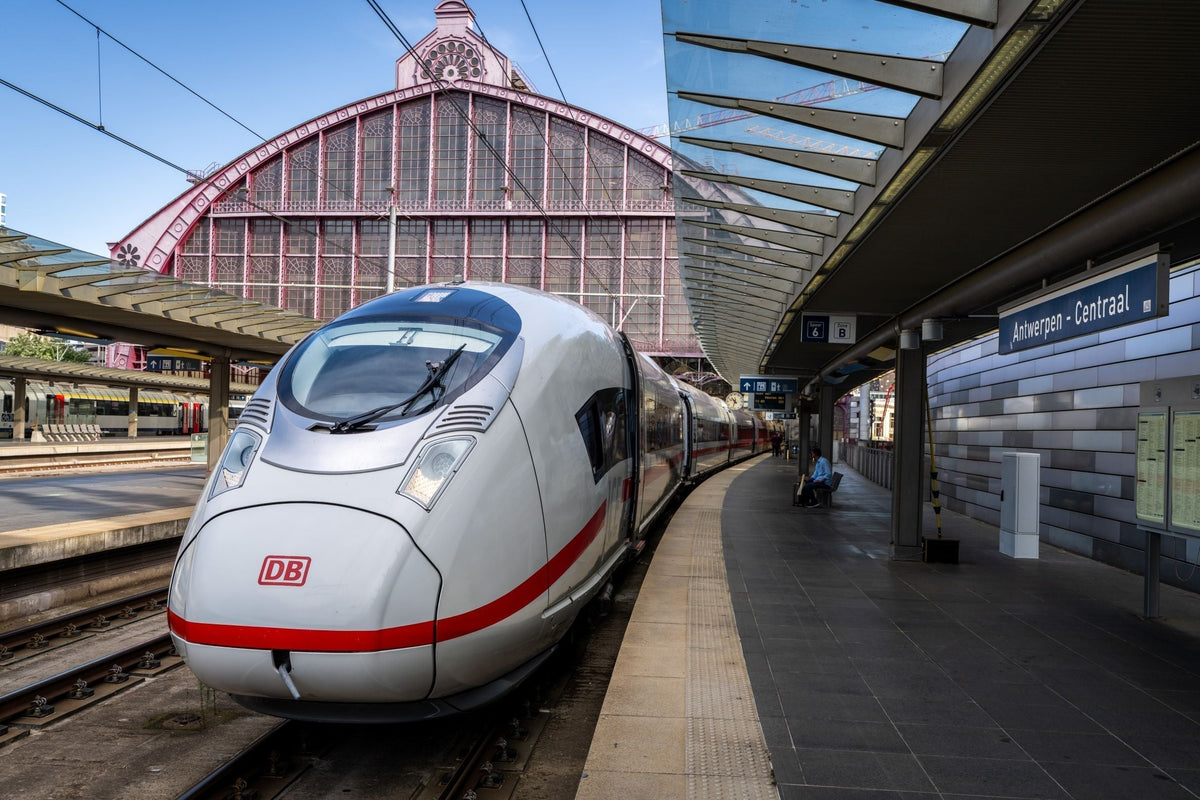
ICE Reaches Antwerpen and Brussels Airport
Deutsche Bahn has extended its ICE network in Belgium, with a new direct service between Köln and Antwerpen starting today, September 7. The trains also provide the first direct ICE connection to Brussels Airport.
Two trains a day operate in each direction between Köln and Antwerpen, calling at Aachen, Liège-Guillemins, Leuven and Brussels Airport. The journey between Köln and Antwerpen takes around two hours twenty minutes, while Köln–Brussels Airport takes less than two hours. The service operates daily.
The new service gives both Antwerpen and Leuven a direct connection to the German ICE network, with Leuven gaining its first permanent direct high-speed connection with Germany.
The new route is operated with ICE 3neo trains, which can carry around 400 passengers and reach speeds of up to 300 km/h.
The new service comes as demand for rail travel between Germany and Belgium continues to grow. DB and SNCB say passenger numbers on their cross-border ICE services increased by around 18% between 2019 and 2025.
For Brussels Airport, the new service also restores a direct high-speed rail connection after more than ten years. Passengers travelling with Brussels Airlines can also use a combined train-and-flight ticket through the existing Lufthansa Express Rail codeshare arrangement, which has been extended to the new Köln–Brussels Airport service.
Train to Culture returns between Warszawa, Poznań and Berlin
PKP Intercity is bringing its Pociąg do Kultury/Kulturzug (Train to Culture) back to the international route between Warszawa, Poznań and Berlin, with a programme of concerts, literary events, workshops, exhibitions and discussions taking place on board selected trains during September and October.
The first Pociąg do Kultury of this year's series will leave Warszawa Wschodnia at 14:49 on September 24, bound for Berlin. A specially prepared cultural carriage will be open to all passengers, with events involving artists and cultural institutions from Warszawa, Poznań and Berlin.
The programme will be carried on eight journeys. The eastbound services are EC 42 on September 24 and 26 and October 7 and 9, with westbound EC 45 operating on September 25 and 27 and October 8 and 10. Participation in the cultural programme is free for passengers with a valid train ticket.
The project dates back to 2016, when the Pociąg do Kultury/Kulturzug was introduced as a weekend service between Berlin and Wrocław, running via Cottbus, Węgliniec and Legnica. The cultural programme was designed to turn the cross-border journey into a venue for concerts, exhibitions, workshops, performances and discussions, bringing people and cultures together during the journey.
The success of the original Berlin–Wrocław project eventually led to the concept being extended to the Warszawa–Poznań–Berlin route. In February 2025, the Pociąg do Kultury/Kulturzug was introduced on this route for the first time as a six-journey pilot, with a specially adapted cultural carriage attached to selected EC Berlin–Warszawa-Express services between February 11 and 16. The pilot ran alongside the original weekend Kulturzug between Berlin and Wrocław, rather than replacing it.
The 2026 programme marks the return of the project to the route, this time with eight journeys and more than 32 individual events planned. The programme, under the slogan “Closer than you think”, includes concerts, literary events, workshops, discussions and exhibitions.
This year's edition also marks several anniversaries: the 35th anniversary of the partnership between Berlin and Warszawa, the 35th anniversary of the Polish German Treaty on Good Neighbourliness and Friendly Cooperation, and the 20th anniversary of the Oder Partnership.
According to PKP Intercity, more than 130,000 passengers have taken part in the Pociąg do Kultury/Kulturzug project since it began. After a decade of connecting Berlin and Wrocław, the project is now using the international EC route to bring its combination of rail travel and cultural exchange to three of Poland and Germany's major cities.
European Sleeper launches Brussels–Milan night train
European Sleeper’s new Brussels–Milan night train starts running today, September 9, providing a direct overnight link between Belgium, Germany, Switzerland and Italy.
There are three departures each week: from Brussels on Mondays, Thursdays and Saturdays, and from Milano on Wednesdays, Fridays and Sundays.
The route takes the train from Bruxelles Midi via Liège-Guillemins, Aachen and Köln before crossing Switzerland on the historic Gotthard route. Stops include Arth Goldau, Göschenen, Bellinzona and Lugano, followed by Como and Milano.
The use of the old Gotthard route is one of the highlights of the journey, taking the train over the mountain railway rather than through the 57-kilometre Gotthard Base Tunnel.
The service is set to expand from December 13, when trains will also call at Antwerpen-Centraal, Breda and Eindhoven. This will provide the Netherlands with a direct overnight connection to Switzerland and Italy, while the longer-term plan remains to extend the service to Amsterdam.
The Brussels–Milan service is European Sleeper’s most southerly route yet, extending its growing network of international night trains into Italy.
Jesenice closure to disrupt Ljubljana–Villach trains
International rail services between Slovenia and Austria will be disrupted for almost seven weeks this autumn while major reconstruction work takes place at Jesenice.
The main line between Lesce Bled, Jesenice and the Austrian border will be completely closed from September 25 to November 12. Replacement buses will operate for passengers, including on the international route between Ljubljana and Villach.
The disruption is being introduced in stages. The Jesenice–Vintgar line is already closed, while the Ljubljana–Lesce Bled section will also have several complete closures between September 26 and November 11. During periods when trains can run to Lesce Bled, passengers will change there for buses to Jesenice and Villach.
The works at Jesenice include reconstruction of tracks and platforms, electrification and signalling improvements, and rebuilding several structures around the station. The wider project is scheduled to continue into 2027.
For passengers travelling between Slovenia and Austria, the practical effect is that the normal train service through Jesenice will be replaced by buses for much of the autumn, with the precise arrangements depending on the stage of the works.
The Summer 2026 edition of the European Rail Timetable is available NOW in print and digital formats and is the perfect partner to our Rail Map Europe.
Image courtesy and copyright of Deutsche Bahn AG / Michael Neuhaus.