Snälltåget Launches New Malmö–Göteborg–Oslo Service
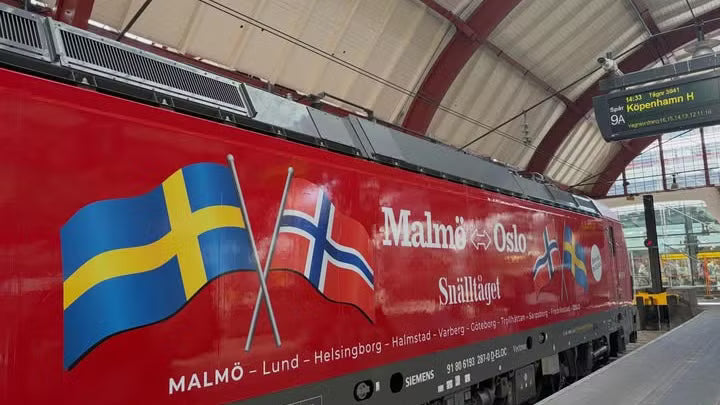
Swedish open-access operator Snälltåget has launched its new direct daytime service linking Malmö, Göteborg and Oslo today (June 15), marking a significant expansion of rail travel options along the Scandinavian west coast. The daily train provides a direct connection between Sweden’s third-largest city, its second-largest city, and the Norwegian capital, offering a new alternative to domestic flights and road travel.
The service departs Malmö C at 06:38 each morning, arriving in Oslo S at 13:16. The southbound train leaves Oslo at 14:48 and reaches Malmö at 21:25. Intermediate stops include Lund, Helsingborg, Halmstad, Varberg, Trollhättan, Sarpsborg and Fredrikstad, as well as Göteborg-Mölndal and Göteborg-Gamlestaden.
One of the route’s key advantages is its integration with Snälltåget’s wider network. Passengers from Oslo and Göteborg can connect in Malmö with the operator’s services to København, Hamburg and Berlin, creating new international rail travel opportunities from both Norway and western Sweden.
Snälltåget says the route is aimed particularly at growing leisure travel within Scandinavia and attracting more passengers to rail. The train is formed of long-distance rolling stock and includes the operator’s restaurant car, Krogen, throughout the journey. Private compartments are also available for groups and families.
The launch comes amid continued growth in cross-border rail services across Europe and strengthens competition on one of Scandinavia’s busiest travel corridors.
Image courtesy of Snälltåget.
Basel–Brussels TGV Service to Launch in Summer 2027
A new direct high-speed rail link between Basel and Brussels is set to launch in July 2027, providing a new international connection between Switzerland, Belgium and France.
The service will be operated jointly by SBB, SNCF and SNCB as an extension of the existing TGV INOUI route that currently links Brussels and Strasbourg.
Initially, the service will operate as a market trial, with one return journey running on Fridays, Saturdays and Sundays. The partners say the new route is intended to strengthen rail travel between three important European markets while providing a more sustainable alternative to short-haul flights.
The train will depart Bruxelles-Midi at around 07:00, calling at Lille-Europe, Roissy Charles-de-Gaulle Airport TGV, Champagne-Ardenne TGV, Meuse TGV, Lorraine TGV and Strasbourg-Ville before arriving at Basel SBB at approximately 12:30.
The return service will leave Basel at around 14:00 and arrive back in Brussels at approximately 19:00.
The extension will also improve onward international connections. Passengers travelling from Switzerland will be able to connect at Lille-Europe for services to London and destinations in the Netherlands. Travellers heading to London are expected to arrive in the British capital at around 20:00 local time.
Tickets are expected to go on sale in Spring 2027.
The announcement comes as European railways continue to explore new international services, particularly on routes where rail can provide a viable alternative to air travel. The new Basel–Brussels link follows several recent initiatives aimed at improving long-distance cross-border connectivity across the continent.
Netherlands introduces train line numbers and launches new network map redesign
The Dutch rail operator Nederlandse Spoorwegen (NS) is set to introduce line numbers for all train services, marking a significant change in how passengers will navigate the national rail network.
Under the new system, both Intercity and Sprinter services will be assigned fixed line numbers, bringing Dutch rail information closer in style to metro and bus networks. The aim is to make journeys easier to understand, particularly during disruptions and when making connections.
Alongside this, NS is launching a nationwide design competition for a new schematic “lines map” (lijnenkaart) that will display the numbered network at stations. The winning design will be rolled out across the country.
Key points:
- Line numbers will be introduced across all train services
- Designed to improve clarity for passengers and reduce confusion during disruptions
- New schematic network map to be designed through a public competition
- Deadline for entries: August 14, 2026
- Pilot testing is already underway (including at Amersfoort Centraal)
- Full rollout expected from the 2027 timetable change
NS says the changes are intended to make the railway easier to understand at a glance, aligning rail information more closely with the way urban transport systems are typically presented.
NS and DB plan new hourly Amsterdam–Germany service
Dutch Railways (NS) and Deutsche Bahn (DB) have formally notified Dutch regulators of plans to introduce a new open-access international service linking Amsterdam with Germany's Rhine-Ruhr region from the 2028 timetable year.
The proposal would see up to six trains per day operate between Amsterdam, Utrecht, Arnhem and a yet-to-be-confirmed destination in western Germany, supplementing the existing ICE services between the Netherlands and Frankfurt. Köln, Düsseldorf and Dortmund have all been identified as possible termini.
According to the notification submitted to the Dutch Authority for Consumers and Markets (ACM), services could begin during the 2028 timetable year, which starts on December 12, 2027. The exact launch date remains subject to operational planning and capacity allocation.
The service would be operated by NS International in partnership with Deutsche Bahn using international versions of NS's Intercity New Generation (ICNG) trains. Eleven Germany-capable units have been ordered, with testing and certification work already underway in Germany. Each eight-car train will provide 409 seats.
Current plans envisage departures from Amsterdam being timed between the existing two-hourly ICE services. Combined with the ICE timetable, this would create an hourly daytime rail link between the Netherlands and Germany for much of the day.
The proposal marks the revival of a long-standing ambition to operate a regular NS-branded intercity service into Germany. Similar plans for a direct Amsterdam–Köln service were explored around a decade ago but were later shelved because of capacity constraints on the route.
Initially, NS and DB are understood to be considering a smaller operation of three daily return trips before expanding to the full six-train schedule outlined in the regulatory filing. Further steps, including securing train paths from infrastructure managers in both countries, are still required before the project can proceed.
If introduced as planned, the new service would significantly increase international rail capacity between the Netherlands and Germany.