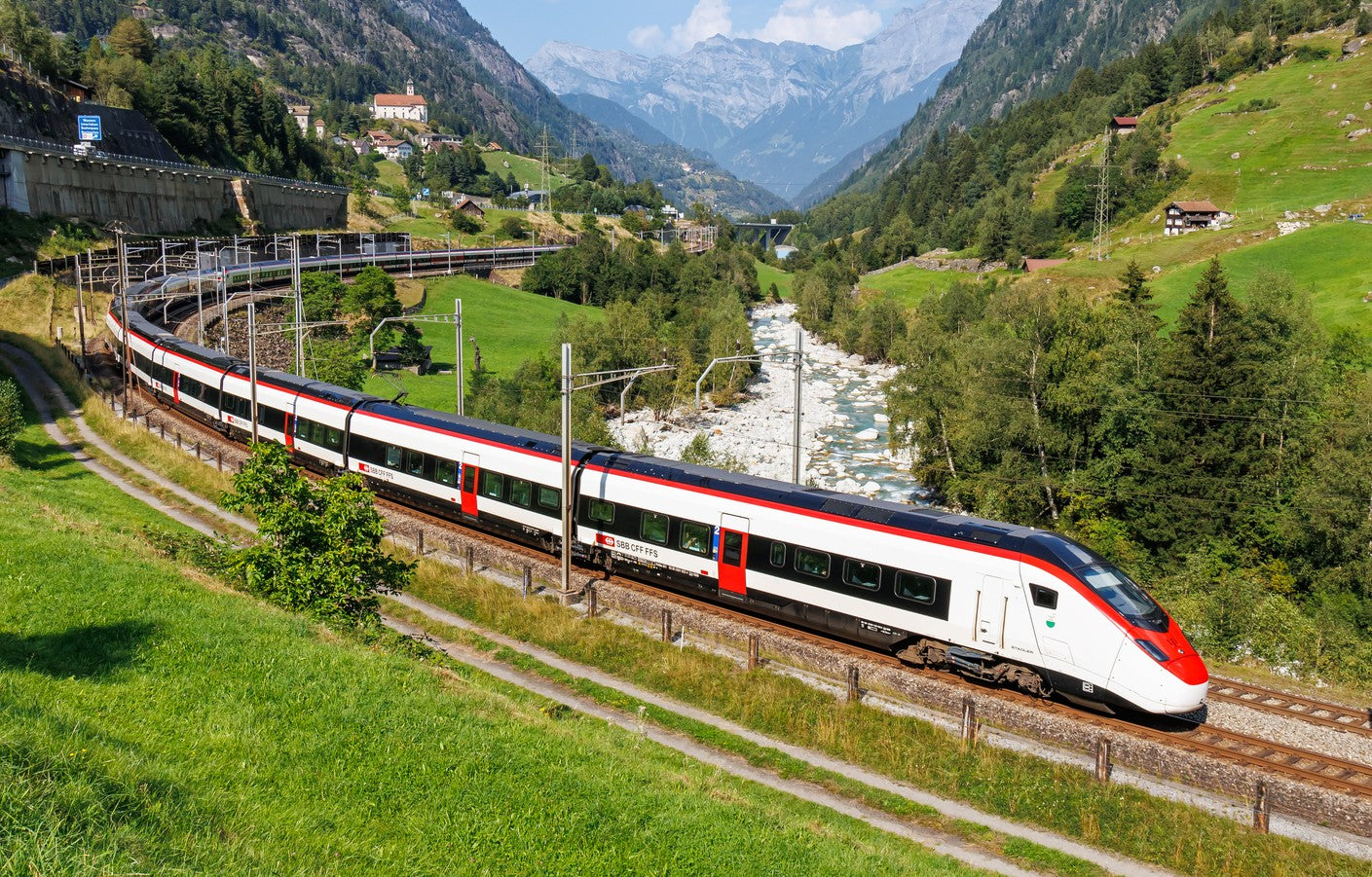
This edition of the European Rail Timetable includes timings valid from the timetable change which commenced on December 14. Firstly we would like to apologise for the delayed publication of this edition which was caused by various production difficulties. It has been a very challenging period for the team, but we are now pleased to be able to present the Spring 2026 edition.
Regular readers will notice a few changes which we hope will make it easier to navigate our tables. Although the basic style of our tables remains the same, the font size within the tables and of the notes has been increased to improve legibility. We have also increased the size of the outer margins to solve the problem of content adjacent to the spine of the book sometimes being difficult to read. These changes have resulted in a slight reduction in the number of services we show, with a small number of lesser used routes and stations having being removed.
INTERNATIONAL
Our international section has been completely revamped with many tables simplified to show only the core through services on each route. Readers are encouraged to consult the relevant domestic tables to explore the many opportunities for onward connections.
Table 10: A fifth through Eurostar service is now running between London and Amsterdam.
Table 11: As this table mainly covers services wholly within France (and cross-border services to and from Brussels) this table has been deleted with services moved to the following tables within the French section: Table 280a for services to Nantes and Rennes; Table 300a for services to Bordeaux; Table 351 for services to southern France. Passengers from London intending to connect with trains at Lille should use the appropriate French table in conjunction with Eurostar Table 10.
Table 13: The Paris to Barcelona daytime and overnight services are now shown in two separate panels within the same table.
Table 14: This Paris – Madrid table has been deleted due to the ongoing poor connections between Irun and Hendaye. Please consult French Table 305 and Spanish Table 689 for journey options via this route.
Table 18 has been simplified by showing the Paris – Brussels – Amsterdam Eurostar services and the Brussels – Amsterdam Eurocity Direct services in separate panels. Note that London – Brussels – Amsterdam Eurostar services are no longer shown in this table; please refer to Table 10 for these.
The low-cost Ouigo service between Paris and Brussels has been amended. The three daily services remain but with changes to the calling pattern. Two services per day in each direction call at Creil (previously three) while St Quentin is served by the morning northbound train to Brussels and the evening return from the Belgian capital.
Tables 20 and 21 have been combined and now only show through international services on the Paris – Brussels – Koln – Frankfurt corridor.
Table 22: Amsterdam – Berlin services were reclassified ICE from November 1. They no longer serve Berlin Ostbahnhof, running to and from the Berlin Hauptbahnhof low level platforms instead. GoVolta, a new Dutch international train company, are planning to introduce services between Amsterdam and Berlin and between Amsterdam and Hamburg from March 19. Initially the services will run out and back from Amsterdam three days a week, running alternately to each German destination. One novel feature will be the ability to reserve a seat opposite so you can face the direction of travel for the whole journey!
Table 28 now only shows through ICE services on the Amsterdam – Frankfurt /Munchen corridor. The last two northbound services have switched their starting stations, meaning the Munchen to Amsterdam through train now runs approximately two hours earlier than before while a later through train runs from Frankfurt to the Dutch capital.
Table 30 now focuses on services between Paris and Frankfurt including the ICE train that extends to and from Berlin. The Berlin service is retimed in both directions and is rerouted to serve Frankfurt Hbf (instead of Frankfurt Sud), Erfurt and Halle. Table 31 (London – Paris – Geneve) has been deleted. Services between Paris and Geneve are shown in French Table 341 with connections from and to London found in Table 10.
Table 32 (Paris – Stuttgart – Munchen) no longer shows connections between Munchen and Wien. Tables 890 and 950 show all possible connections to and from Wien.
Table 40 now only covers the Paris to Zurich route; onward connections to and from Milano can be found in Table 82.
Table 44 provides timings for TGV and Frecciarossa services between Paris and Milano. Please consult the Italian section for the multitude of connections available to other Italian cities.
Connecting trains to and from Porto have been removed from Table 46; these can be found in Portuguese Table 690.
Table 50: The proposed thrice weekly Basel – Malmo NightJet service from April 15 will notnow be introduced. Snalltaget will introduce a daily day service between Stockholm and Hamburg (train 307/306) from May 4. The Berlin Night Express (train 301/300) will resume from April 7 between Stockholm and Berlin; this service will extend to Dresden on certain Fridays, returning the following Sunday.
Table 54: EuroNight 40458/40459 Canopus Praha – Leipzig – Zurich no longer conveys couchette accommodation.
Table 56: Two new daily Leipzig – Krakow EuroCity services (135/134 and 133/132) have been introduced, running via Węgliniec. Train 135/134 extended to / from Przemysl. A seventh Berlin-Warszawa-Express service in each direction (numbered EC43/42) has been introduced, meaning there is now a service every two hours throughout the day between the two capitals.
A new overnight service between Berlin and Chelm (IC 441/440) has commenced running, routed via Poznan , Lodz and Warszawa. It only conveys second class seats, but includes through cars (numbered 431/430) operating between Berlin and Przemysl. The Kulturzug / Pociag do Kultury which has previously run between Berlin and Wrocław is currently suspended; the service may resume during the summer although this has not been confirmed.
The international service between Praha and Wien via Ceske Velenice and Gmund NO is now shown in its entirety in a new Table 57. The sleeping-car service between Praha and Zurich via Linz (previously shown in Table 52) was temporarily withdrawn in December 2024 due to engineering work taking place in Austria. However, we understand that it has now been permanently withdrawn. The through service between Praha and Zurich via Leipzig (EN 40458/40459 Canopus) continues to run and is shown in Table 54.
Daytime services between Praha and Linz (formerly shown in Table 52) are now included in a new Table 59.
Table 60: With the opening of the Koralmbahn high-speed line between Graz and Klagenfurt, the previous two-hourly Praha – Wien – Graz service has been reduced to just three daily trains in each direction, all of which are extended to and from Villach. EC 173/172 Hungaria Berlin – Budapest, is reclassified and renumbered as RJ 175/174 and so no longer conveys Hungarian carriages (including the Hungarian restaurant car); it now operates with Czech Comfortjet cars marketed as Railjet. In addition, it no longer calls at Praha hlavni nadrazi (avoiding the necessity to reverse direction), but continues to call at Praha Holesovice. Note that RJ 175 runs approximately two hours later from Berlin. RJ 250
Wien – Berlin and RJ 251 Berlin – Villach also no longer serve Praha hl. n. There is a new early morning departure from Wien to Praha at 0510 (RJ 258) and a new later return service departing Praha at 1837 as RJ 259. Three Railjet services between Praha and Berlin will extended to and from Kobenhavn from May 1.
Table 61: IC 73/72 Traianus Budapest – Craiova is extended to and from Bucuresti thus resuming a day service between the Hungarian and Romanian capitals. IC 73 runs two hours earlier than before, leaving Budapest Keleti at 0510. We understand that a two- hourly through EuroCity service will commence soon between Budapest and Beograd, two of which will extend from and to Wien.
Table 62 has seen numerous changes following the opening of the Koralmbahn in Austria. Most of the former EuroCity services between Germany and Klagenfurt have been extended to and from Graz with altered train numbers and reclassified as either RJ or ICE. The former EuroCity services which ran between Germany and Graz via Selzthal are diverted to run via Klagenfurt. There is a new early morning departure from Klagenfurt to Munchen at 0453 (EC212) and a corresponding later southbound journey departing Munchen at 2018 (RJ 215). Train number EC115 is now allocated to a Munchen to Zagreb through service departing Munchen Hbf at 1016. Until June 13 the corresponding return journey runs as two separate services which connect at Villach Hbf: EC214 Zagreb – Villach and EC114 Villach – Munchen. From June 14 EC114 will also become a direct service from Zagreb to Munchen.
Table 63: A restaurant car is now conveyed for the entire journey on all Baltic Express services between Praha and Gdynia.
Tables 64 and 66 have been combined into a revamped Table 64. Engineering work taking place from February 7 to June 13 between Nurnberg and Regensburg will have a major impact on services between Germany and Austria via Passau. A much reduced service
will operate with services diverted via Ingolstadt resulting in extended journey times. Services on this route will be affected further from June 14 when the line between Regensburg and Passau is temporarily closed.
International WESTbahn services on the Stuttgart – Munchen – Wien Westbahnhof route have been added to Table 65.
Table 71: Nightjet 40295/40230 Munchen – Milano and 233/230 Wien – Milano trains are suspended for the 2026 timetable period. The two Railjet Xpress services between Wien and Venezia have been moved to new Table 80, as have the Stuttgart / Wien – Venezia Nightjet services. The reinstated Munchen/Wien – Roma Nightjet services are the only trains currently shown in Table 71.
Table 73: Nightjet 403/402 Amsterdam – Zurich has been moved to Table 53. The long-standing loco-hauled EuroCity services 6, 7, 8 and 9 between Germany and Switzerland have been withdrawn and replaced by ICE services as part of a general revamp of through
services between the two countries. Of note, Brig is added to the list of stations in Switzerland with regular through ICE services to German cities (together with long-standing direct links with Interlaken, Zurich and Chur).
Table 78: European Sleeper will introduce a new Paris – Brussels – Berlin service from March 26 running three nights per week (in addition to the existing three night a week service between Brussels and Berlin). This means an overnight service between Brussels and Berlin will be available six days per week. ES496 will depart Paris on Tuesdays, Thursdays and Saturdays at 1745, Brussels at 2145, arriving Berlin Hbf at 0959. The return service, ES 497, will depart Berlin Hbf on Mondays, Wednesdays and Fridays at 1831 arriving Brussels at 0706 and Paris at 1000. European Sleeper offers couchettes in one to five-berth configurations on all of its services. European Sleeper are also planning to introduce a thrice weekly service between Brussels / Amsterdam and Milano from mid-June. Brussels and Amsterdam portions will run separately with the cars combining / spliting in the Koln area. We have created a new Table 78a for this service but no timings are currently available.
Table 80: The opening of the Koralmbahn high-speed route between Wien and Klagenfurt has enabled the Wien to Venezia journey time to be reduced by 30 minutes to 7 hours and 10 minutes. The two existing Railjet services between Wien and Venezia have been recast and now call additionally at Graz. An additional Railjet service RJX 132/131 has also been introduced between Wien and Trieste. The local services between Villach and Trieste are now shown in a separate table. A new Railjet service is expected to be introduced soon between Wien and Ljubljana via Graz and Villach.
Table 82 has been split into three separate panels: Geneve – Milano, Basel – Milano and Zurich – Milano. One additional pair of EuroCity services has been introduced between Zurich and Milano increasing the daily service between the two cities to twelve train pairs. A further train pair from Zurich, EC33/32, will commence on March 29 running to and from La Spezia (with extension to Pisa and Livorno on Fridays and Saturdays, returning the following day).
Table 86: NightJet 465/464 Zurich – Graz is rerouted via Villach and Klagenfurt instead of via Selzthal. The daytime service between the two cities (EC164/163 Transalpin) continues to run via Selzthal, the last remaining international service to do so. Table 92 has been merged into a revamped Table 89. Former train 159/158 Croatia Graz – Zagreb is extended to run from and to Wien and renumbered EC 79/78, thus restoring the through EuroCity service between the two capital cities. EC 151/150 Emona Wien – Ljubljana is renumbered EC71/70 with the through cars to and from Villa Opicina withdrawn. Just before our press
deadline we discovered that summer service EN 1273/1272 Bratislava – Wien – Split may no longer run between Bratislava and Wien and that it may have a reduced operating period. We are also waiting for confirmation regarding the Warszawa – Wien – Rijeka summer service.
Former Table 49, showing the Vilnius – Riga – Tallinn services, has been renumbered 91. A new service between Riga and Tallinn was introduced from January 12.
Table 96: The through sleeping car Wien – Budapest – Szolnok – Kyiv (40347/749 Hortobagy) is now conveyed on train 347/348 between Wien and Szolnok.
Former Table 58 has been renumbered 97 and includes a new Szczecin – Poznan – Warszawa – Mockava service (EC146/145). See the ‘Poland and Lithuania’ entry for further details.
Our Warszawa – Kyiv table has been renumbered from 59 to 98.
In Table 99, two additional EuroCity services have been introduced: EC307/306 between Graz and Wrocław and EC204/203 between Wien and Krakow. EC107/106 Przemysl – Krakow – Graz is cut back to run Krakow – Graz and renumbered 207/206. EN407/406 Chopin Munchen – Warszawa has gained additional through cars operating between Munchen and Przemysl, numbered EN40417/40416 and named Carpatia. EC303/302 Graz – Wroclaw has been extended to and from Poznan. Leo Express services between Praha and Krakow are recast and, from March 1, two new services will operate between Praha and Warszawa via Krako w. A new Regiojet service is also operating between Praha and Warszawa.
GREAT BRITAIN
The timetable change in Great Britain has seen improved frequencies, clearer patterns and extended connectivity on several key routes. The most high-profile development is the complete revamp of the East Coast Main Line timetable between London, Leeds, York, Newcastle and Edinburgh. A broadly clock-face structure will operate every two hours, with only minor variations. Sunday services largely mirror the weekday pattern, although timings differ slightly. Schedules are now presented in two separate tables: New Table 179 covers London – Leeds, Bradford, Harrogate and Lincoln (together with services that only run as far as York). Table 180 focuses on the core London – York – Newcastle – Edinburgh service.
In the South East of England, several full tables have been included within a revamped Table 102 showing services from London to popular destinations south of London together with a summary of services along the south coast Ashford – Brighton – Portsmouth – Southampton corridor.
Table 136 has been simplified to show schedules only between Cardiff and Carmarthen. Timings of those trains heading further west to Pembroke, Milford Haven and Fishguard are now shown in new Table 137.
The Caledonian Sleeper Highlander service (London – Inverness / Aberdeen / Fort William) now includes a station call at Birmingham International in both directions (Table 161).
East Midlands Railway has revamped its Peterborough – Lincoln – Doncaster service. A regular hourly service operates throughout the day between Peterborough and Lincoln (Table 176), but only the first train of the day from Peterborough runs through to Doncaster. Five trains per day run each way between Lincoln and Doncaster (Table 176a). East Midlands Railway services between Matlock, Derby, Nottingham and Lincoln have been combined to form an hourly Matlock – Lincoln service seven days a week, with alternate trains extended to Cleethorpes on Mondays to Saturdays (with two such extensions on Sundays). A revamped Table 189 has been created to show the new service. On Mondays to Saturdays the Crewe – Newark Castle service is extended to Lincoln (Table 155). These changes have improved connectivity on the busy Lincoln – Nottingham – Derby corridor.
Northern has reduced its Sunday service to one train every two hours on some of its routes, most notably Blackpool to Liverpool (Table 162) and Manchester to both Buxton and Southport (Table 163). Certain Sunday services have also been removed on the Manchester to Blackpool route (Table 156), together with selected stopping services on the Manchester to Sheffield line (Table 194). The tunnel south of Whitehaven station remains closed for repairs, so timings in the Barrow to Carlisle Table 157 take into account the short rail replacement bus service between Whitehaven and Corkickle. This temporary timetable is expected to remain in force until May.
In the north-east of England, Northern has implemented a substantial recast of services covered in Tables 209 to 212. Both the Middlesbrough – Newcastle and Newcastle – Carlisle corridors now have a regular pattern of two trains per hour with one service every hour operating as a through service. Trains on the Saltburn – Darlington – Bishop Auckland route have also been retimed to provide a regular service pattern throughout the day. A new Table 229a has been created to show a summary of rail-sea schedules between London and Douglas (on the Isle of Man).
FRANCE
A second daily out and back Intercites service is now running between Nancy and Lyon via Dijon meaning both a morning and afternoon service is now available in each direction (Tables 377 and 379a).
BELGIUM
On Saturdays and Sundays an additional hourly fast train links Brussels with Liege via Brussels Airport (Table 430); this is an extension of the Knokke – Brussels service shown in Table 405. Former Table 425 has been incorporated into Table 416 in order to better show the Lille – Charleroi – Namur trains.
NETHERLANDS
The Zwolle – Arnhem – Nijmegen – Breda – Roosendaal service (Table 475) has been extended once per hour through to Vlissingen. As a result only one train per hour runs through from Amsterdam to Vlissingen at weekends, the other hourly train terminating at Roosendaal. These changes have necessitated a separate Table 451 for Roosendaal to Vlissingen, with the old Table 451 being renumbered 454.
Trains from Alkmaar and Enkhuizen to Amsterdam, Utrecht, Eindhoven and beyond (Table 470) run in a revised pattern. Enkhuizen trains no longer continue beyond Amsterdam on Fridays to Sundays, so a separate Table 456 has been added for Enkhuizen to Amsterdam.
Through trains between Groningen and Leer were expected to commence with the December timetable change, but the opening of the Friesenbrucke to rail traffic has been delayed, and the replacement bus service continues for the time being, as shown in Table 495.
A new Table 497 shows the principal heritage railways in the Netherlands, whilst several other tables have been renumbered for space reasons, notably former Table 493 Zwolle – Emmen is now 466. The Rotterdam section of the old Table 452 will now be found in new Table 453.
SWITZERLAND
Thanks to recent infrastructure improvements, an hourly direct IC service has been restored between Basel and Lausanne via Delemont and Biel/Bienne. The section between Basel and Biel/Bienne will operate on a half-hourly basis with operator BLS providing the extra service each hour. Our Swiss tables in this area have been adapted to show the revamped service pattern.
A new Table 501 has been set up to show all long-distance trains via Biel/Bienne (including the new services to and from Basel). Table 500 focuses on services along the Geneve – Lausanne – Bern – Zurich corridor. A new Table 502 shows the limited number of direct IR services between Geneve and Neuchatel. The branch line services between Nyon and La Cure and between Morges and Biere, previously shown in Tables 501 and 502, have been moved to a new Table 503 while the Yverdon to Fribourg table has been renumbered from 503 to 504.
The fast IC services between Zurich and Chur now run every 30 minutes for most of the day, from approximately 0600 to 2000 (Table 520). An additional direct Geneve – Lausanne – Bern – Zurich – Chur weekend service has been added to the schedules meaning there are now five such services running in each direction on Saturdays and Sundays (Tables 500 and 520).
ITALY
Following the end of long-term engineering work, rail services between Nice and Breil sur Roya have resumed (Table 581).
Services in Table 597, the international route from Lienz via San Candido / Innichen, have reverted to their traditional Italian terminus of Fortezza / Franzensfeste.
A new section of track has opened allowing services from Milano Malpensa airport to run directly to Gallarate, reducing journey times between Malpensa Terminal 2 and Gallarate from 34 minutes to as little as 8 minutes (Table 606).
Rail services in Table 641 are currently suspended to allow for engineering work. A rail replacement bus service is in operation.
SPAIN
Engineering work between Madrid and Soria / Zaragoza, which was originally expected to end in December, is now forecast to be completed by mid-March (Table 651).
Work to add an additional track between Parets del Valles and La Garriga is affecting services between Barcelona and Vic until May 2026 with a rail replacement bus service operating between Fabrai Puig and Vic (Table 656).
Spanish Railways has adjusted the timings of its early morning services from Granada and Malaga to Madrid (Table 660). The 0612 from Granada now departs at 0614, no longer calls at Antequera-Santa Ana and arrives Madrid at 0936, reducing the journey time by ten minutes. The 0648 departure from Malaga now departs at 0705 and runs non-stop to Madrid saving 17 minutes. Journey times of most other services between Granada and Madrid are reduced by around five minutes.
There have been some re-timings on the Madrid Puerta de Atocha to Pamplona/Iruna route (Table 654).
Services between Madrid and Irun have been fully restored following the completion of engineering work (Table 689).
DENMARK
Engineering work will affect services in the Aarhus area until April 19 with some trains retimed by a few minutes while others are partially replaced by bus. The most significant changes are in Tables 701 and 703 and special versions of these tables will be found on page 570 outlining the amended timings. Other changes are indicated by individual footnotes or by a general warning within the relevant tables.
GERMANY
Some of the larger and more complex tables in the German section have been reformatted and split into two separate tables which we hope will provide more clarity and make them easier to understand. Long-distance services via Koblenz have been moved from Table 800 to a new Table 801. Table 900 now only shows services on the direct route between Munchen and Hamburg with trains between Frankfurt and Hamburg moved to a new Table 901. The complex Table 910, which previously showed all long-distance services via Mannheim has also been split into two with Table 910 showing services to and from Basel, with a new Table 911 showing trains running to and from Stuttgart and Munchen. Note that a number of regional tables have also had to be renumbered to accommodate these changes.
German Railways has expanded the number of key corridors where ICE trains run every 30 minutes. 21 cities now enjoy a half-hourly long-distance service including Hamburg – Hannover – Kassel and Berlin – Halle – Erfurt. The frequency of trains on the important Hamburg – Frankfurt and Berlin – Munchen corridors is improved by the addition of 14 new limited-stop ICE Sprinter services.
A brand new daily ICE Sprinter service links Stuttgart with Berlin via Nurnberg; with a journey time of 4 hours and 45 minutes, it cuts more than an hour from the previous best timings between the two cities. The northbound train departs Stuttgart at 0703 with the return service leaving the German capital at 1612 (Table 850).
German Railways has also simplified its long-distance service structure with more consistent route and stopping patterns, together with a reduced reliance on train splitting and joining which can exacerbate train delays. This does mean that some direct journeys are no longer available, but it should result in a more stable and predictable system. A good example is that ICE services from Kiel generally run on a regular two-hourly pattern on the same route via Hannover and Frankfurt to Stuttgart (Table 901). Previously services ran to a variety of destinations with less consistent timings.
The new ICE-L train fleet is now operating a small number of services on the Berlin to Koln route, offering low-floor, fully accessible boarding. Following the reopening of the Hamburg to Berlin corridor on May 1, ICE-L trains will start being utilised on the route to Westerland, and will later be seen on the Dortmund to Oberstdorf Allgau service.
The important Berlin to Dresden corridor benefits from the opening of the rebuilt main line through the Berlin suburbs between Berlin Sudkreuz and Blankenfelde, cutting overall journey times from over two hours to just 95 minutes (Table 839). The construction of an additional connecting curve of track has also enabled Airport Express services between Berlin Hbf and Berlin Brandenburg Airport to complete the journey in just 20 minutes (Table 847a).
Despite the welcome service improvements outlined above, other major projects to improve infrastructure will cause significant disruption to services in 2026. The Hamburg to Berlin rebuild will continue until the end of April, with journey times remaining approximately 45 minutes longer until the work is complete. Other major works affecting long-distance services are: Nurnberg – Regensburg from February 6 to June 14; Koln – Hagen via Wuppertal from February 6 to July 10; Hannover – Hamburg from May 1 to July 10; Regensburg – Passau from June 14 to December 14. Special versions of a number of German tables will be found on pages 571 to 574 with details of amended timings during these periods of engineering work.
AUSTRIA
Probably the most significant European rail development at the recent timetable change was the full opening of the Koralmbahn, the new high-speed line linking Graz and Klagenfurt. This 127-kilometre line, featuring the remarkable 33-kilometre Koralm Tunnel, has cut travel times between Wien and southern Austria by approximately 20 minutes, bringing the fastest journey between Wien and Klagenfurt down to just 3 hours and 34 minutes. The maximum permitted speed of 250 km/h on the new section of line has enabled frequent, high-speed services between Wien and southern Austria, thus transforming travel opportunities.
For the city of Graz, the Koralmbahn brings a dramatic expansion of both domestic and international connections. The journey between Graz and Klagenfurt, which previously relied upon a two-hourly direct bus taking two hours, has been transformed. Travellers now benefit from one to two trains per hour taking as little as 41 minutes, a game-changer for commuters and leisure travellers alike. A two hourly fast Railjet Xpress (RJX) service links Wien Hbf with Villach, stopping only at Wien Meidling, Bruck an der Mur, Graz and Klagenfurt. Some of these services extend internationally, providing direct connections between Praha and Villach via Wien and Graz, as well as faster journeys between Wien and northern Italy.
Complementing the RJX services are hourly semi-fast Railjet (RJ) services from Wien, stopping at additional stations such as Weststeiermark and St. Paul im Lavanttal on the new line. These services provide further options for passengers travelling between regional hubs, with some continuing onward to Lienz or Salzburg via Bad Gastein. Meanwhile, the former EuroCity (EC) trains connecting Graz with Munchen have been upgraded to ICE or RJ status, rerouted via the new infrastructure, Klagenfurt and Villach, resulting in reduced journey times and much improved international connections.
Independent operator WESTbahn will be introducing its own services between Wien and Villach from March. Initially three return journeys will commence running from March 1 with two further services added in each direction from March 16. Please see Table 980 on pages 457 and 458 for full details of the new services utilising new route. Passengers wishing to visit stations along the original main line between Bruck an der Mur and Villach have not been forgotten as a new hourly InterRegio (IR) service is now provided calling at all the main stations previously served by long-distance services (see also the entry below). These have, of course, been perfectly timed to connect with other main line services. A small number of through IC services are also available ensuring that places along the classic route still have a direct link to the Austrian capital (Table 979).
Another new feature of the new timetable is the introduction of a new train category: InterRegio (IR). Services under this category provide regular long-distance connections along the following secondary routes: Graz – Bruck a. d. Mur – Leoben – Unzmarkt – Villach (Table 979); Graz – Leoben – Selzthal – Linz (Tables 974 and 975); Graz – Bruck a. d. Mur – Leoben – Selzthal – Bischofshofen – Zell am See – Worgl - Innsbruck (Tables 960 and 975); Salzburg - Bischofshofen - Zell am See - Worgl (Table 960). These long-distance trains convey first- and second-class seating which may be reserved in advance. Catering is also provided in the form of either a vending machine or trolley service.
POLAND and LITHUANIA
PKP and Lithuanian operator LTG Link have greatly improved the service between Poland and Lithuania. As well as IC 141/142 Hancza from Krakow to Mockava (Lithuania), there is a new through service between Szczecin and Mockava, numbered IC 145/146. A third train pair between Suwaki and Mockava IC 139/140 Jacwing improves the journey options further. Jacwing is named after an ancient people who once inhabited this area of Poland and Lithuania. See Table 1042 for full details.
CZECH REPUBLIC
Through Plzen – Brno trains have been split and now run Plzen – Ceske Budejovice (Table 1125) and Ceske Budejovice – Brno (shown in a new Table 1126). The former Table 1126 has been renumbered to 1127.
All trains between Praha and Ostrava now require compulsory reservation (Table 1150). This also applies to journeys between intermediate points, for example from Kolin to Zabreh na Morave.
SLOVAKIA
The end of long-term engineering work on the route covered by Table 1170 means through trains have been restored between Bratislava and Banska Bystrica.
Slower trains between Bratislava and Puchov /Zilina will be numbered 107xx until June 13, after which time they will regain their three-digit 7xx numbers and will all run between Bratislava and Zilina (note that timings of the extensions to and from Zilina are not shown but will be similar to trains that currently run along the entire route).
HUNGARY
The winding cross-country IR service from Gyor to Kaposvar has been split with trains now running Gyor – Tapolca – Keszthely and Tapolca – Kaposvar (Table 1232). Connecting between the two sections of the route now requires a long wait at either Tapolca or Keszthely.
ALBANIA
Albanian operator HSH has suspended all services until further notice due to ongoing engineering work and line upgrades.
BULGARIA
For ease of use, Table 1500, the table showing services between Sofia and the Bulgarian Black Sea coast, has been split into separate panels showing the northern (via Mezdra), central (via Karlovo) and southern (via Plovdiv) routes.
ROMANIA
High summer trains to the coastal resorts south of Constanta have been removed from the regular tables and given their own dedicated table, numbered 1685, to make it easier to consult the full timings. The table is presented in three separate panels: North central destinations Cluj Napoca, Baia Mare and Satu Mare; North eastern destinations Bacau, Iasi and Suceava; North western destinations Arad, Oradea and Timisoara. See page 536 for full details.
BALTIC STATES
Due to ongoing engineering work, schedules in Table 1805 change frequently so readers are advised to check timings before travelling on services in this table.
KAZAKHSTAN and UZBEKISTAN
This edition sees Kazakhstan Temir Joly and Ozbekiston Temir Yo’llari improve the service between Almaty and Toshkent, from three days per week to daily operation. Please see Table 1880, train number 1, for full details. This edition also sees new entries for the Kyrgyzstan and Tajikistan capital cities of Bishkek and Dushanbe which will be found in Table 1890.
PETER WELLER’S RETIREMENT
At the end of 2025, after twelve years of service, our colleague Peter Weller took a well- earned retirement from his timetable compiling duties. Peter worked on the timetable for a period of time at Thomas Cook before becoming involved with the newly formed European Rail Timetable company in 2014. Over the years Peter has worked mainly on the British section, but has also occasionally helped out with other areas of the timetable. He was also our Subscriptions Manager until December 2023 and helped to promote the timetable at various rail related shows. All of us at European Rail Timetable would like to thank Peter for all of his hard work during his time with us and wish him a long and happy retirement.
You can buy the Spring 2026 digital edition here or pre-order the printed edition here.